
Understanding how location, apartment type and tenant demand influence rental income in Budapest.
Budapest’s residential rental market has matured significantly over the past decade. Demand from international professionals, university students and relocating workers continues to support a stable long-term rental sector across the city.
For property owners and investors, the key question remains straightforward: how much rent can your Budapest apartment realistically achieve in today’s market?
The answer depends on several factors including location, apartment size, condition, furnishing level and the type of tenants the property attracts. In 2026, relatively small differences in these variables can result in monthly rental differences of 80,000–150,000 HUF for otherwise comparable apartments.
Understanding these dynamics is essential whether you are planning to rent out your home, evaluating an investment property, or deciding whether to hold or sell an apartment.
Budapest Rental Market Snapshot 2026
Several structural trends continue to shape Budapest’s rental market:
• Continued demand from international professionals working for multinational companies
• Strong student demand driven by Budapest’s universities
• Limited supply of renovated apartments in prime central districts
• Increasing tenant expectations for modern interiors and furnished properties
• Growing landlord preference for stable long-term rentals over short-term letting
Together, these factors support consistent rental demand across central and inner residential districts.
Typical Budapest Rental Prices by Apartment Size (2026)
These figures represent TYPICAL ADVERTISED LONG-TERM RENTS ACROSS THE BUDAPEST MARKET and provide a general benchmark before examining district-level differences.
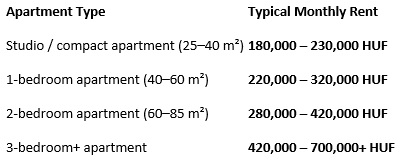
These figures assume well-presented apartments offered on long-term leases.
Prime renovated apartments in central districts may achieve higher rents, particularly when they include high-quality interiors or larger floor areas.
How Rental Costs Are Structured in Budapest
In Budapest’s long-term rental market, tenants typically pay both the monthly rent and the ongoing running costs of the apartment.
This usually includes:
• building common costs (közös költség)
• electricity
• gas
• water
• internet and other utilities
Rental listings are therefore usually advertised as “rent + utilities”, rather than an all-inclusive monthly price.
For property owners, this structure means that operating costs are generally passed directly to tenants, allowing rental income to reflect the rent paid for the property itself.
How Location Influences Rent
Location remains the single most important factor influencing achievable rent.
Budapest’s rental market can broadly be divided into three zones: prime central districts, inner residential districts and outer residential districts.
Prime Central Districts
Districts V, VI, VII and the most central parts of District XIII typically command the highest rents due to proximity to offices, transport connections and cultural amenities.
Typical rents:
• Studio / compact apartments: 180,000 – 250,000 HUF
• 1-bedroom apartments: 240,000 – 360,000 HUF
• 2-bedroom apartments: 320,000 – 500,000 HUF
• 3+ bedroom apartments: 450,000 – 750,000+ HUF
Well-renovated one-bedroom apartments in District VI frequently achieve around 320,000–350,000 HUF per month, particularly when fully furnished and located on desirable central streets.
These districts attract international professionals, corporate relocations and tenants seeking walkable central locations.
Inner Residential Districts
Districts VIII, IX, XI and parts of District XIII offer a balance between affordability and accessibility.
Typical rents:
• Studio / compact apartments: 180,000 – 240,000 HUF
• 1-bedroom apartments: 230,000 – 320,000 HUF
• 2-bedroom apartments: 300,000 – 430,000 HUF
• 3+ bedroom apartments: 390,000 – 600,000 HUF
These neighbourhoods are particularly popular with young professionals and postgraduate students, creating stable tenant demand for modernised apartments.
Newer developments in District IX and District XI can command higher rents within these ranges.
Outer Residential Districts
Districts XIV, XV, XVI, XVII, XVIII and XIX generally achieve lower rental levels but still offer stable long-term tenants.
Typical rents:
• Studio / compact apartments: 160,000 – 210,000 HUF
• 1-bedroom apartments: 190,000 – 260,000 HUF
• 2-bedroom apartments: 230,000 – 310,000 HUF
• 3+ bedroom apartments: 280,000 – 380,000 HUF
While rental levels are lower, purchase prices are typically more affordable, which can produce attractive gross rental yields for investors.
Apartment Size and Layout Matter
The layout efficiency of an apartment can influence rental value almost as much as its size.
A well-designed 50 m² one-bedroom apartment, for example, may achieve higher rent than a poorly arranged 65 m² apartment with limited natural light or inefficient circulation.
Apartments with separate living and sleeping areas generally attract professional tenants willing to pay higher rents. Storage space, modern kitchens and natural light also play an important role in tenant decision-making.
In central Budapest, tenants increasingly prioritise functional layouts and comfortable living spaces over raw floor area.
Furnished vs Unfurnished Apartments
Most apartments rented to international tenants in Budapest are offered fully furnished. Tenants increasingly expect apartments that feel complete and ready to live in from the first day.
A typical furnished rental usually includes:
• bed and mattress
• sofa and dining table
• wardrobes and storage
• washing machine
• fully equipped kitchen appliances
Well-presented furnished apartments often command a noticeable rental premium over comparable unfurnished properties, particularly in central districts and when targeting international tenants or corporate relocations.
Many successful landlords favour simple Scandinavian-style interiors, neutral colours and durable materials. These interiors photograph well and appeal to a broad tenant base.
In Budapest’s rental market, presentation has become almost as important as location when attracting high-quality tenants.
Long-Term vs Short-Term Rentals
Short-term rental platforms once attracted many Budapest property owners seeking higher potential income. However, the market has evolved significantly in recent years.
Operating short-term rentals now typically involves:
• stricter municipal regulations
• higher operating costs
• professional guest management
• fluctuating occupancy rates
For many property owners, long-term rental provides more predictable income and lower operational complexity.
Across much of Budapest, a well-located long-term rental apartment can generate approximately 2.4 – 5.0 million HUF in annual rental income before tax, depending on apartment size, location and condition.
Renovation and Condition
Condition has become one of the most important rent differentiators in Budapest’s rental market.
Two apartments within the same building can achieve significantly different rents depending on renovation quality.
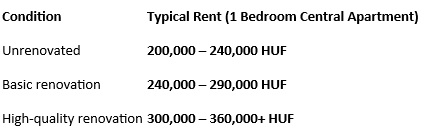
Investors often underestimate how strongly interior quality, lighting and kitchen design influence tenant demand.
Simple upgrades such as modern bathrooms, neutral colour palettes and quality flooring can significantly improve rental performance.
Common Landlord Pricing Mistakes
Many apartments remain vacant longer than necessary due to unrealistic pricing expectations.
Common mistakes include:
Pricing based on emotional value
Owners sometimes anchor rental expectations to purchase price or renovation cost rather than current tenant demand.
Comparing with premium listings
Landlords may set rent based on the highest listings visible online rather than comparable apartments that have actually been rented.
Ignoring presentation differences
Apartments of identical size in the same district can achieve very different rents depending on renovation quality, layout and furnishings.
Even overpricing by 20,000–30,000 HUF per month can significantly extend vacancy periods.
5 Practical Questions Buyers and Investors Are Asking
1. How quickly do apartments typically rent in Budapest?
Well-presented and realistically priced apartments in strong locations usually attract tenant interest quickly, while overpriced properties can remain on the market significantly longer.
2. What rental yield can investors expect?
Many residential investment properties in Budapest generate approximately 4–6% gross rental yield, depending on district, purchase price and renovation level.
3. Do tenants prefer furnished apartments?
Yes. Most international tenants expect furnished apartments, particularly in central districts.
4. Which apartment sizes are easiest to rent?
Studios and one-bedroom apartments typically have the largest tenant pool and the lowest vacancy risk.
5. Is rental demand still strong in Budapest?
Yes. Demand remains supported by international companies, universities and continued population movement into the capital.