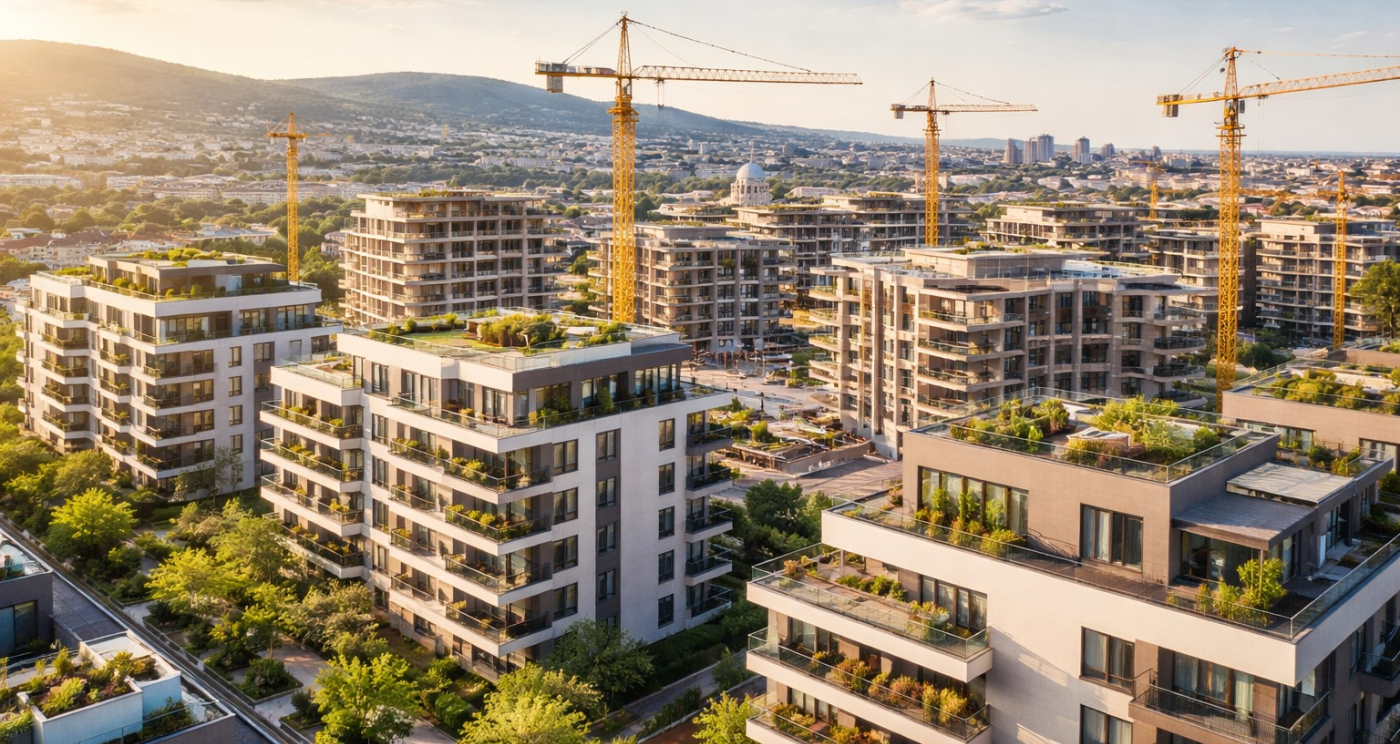
The new-build apartment market is gaining momentum again, and for buyers planning a move in 2026, the details matter more than ever. Construction activity has picked up, more homes are working their way through the pipeline, and upcoming handovers are becoming easier to map especially when you break the market down district by district.
What’s emerging isn’t a uniform surge, but a patchwork of localised conditions that can dramatically change how competitive or flexible , your buying experience may be.
Construction activity: where the biggest pipelines are
At the start of 2026, roughly 7,600 newly built apartments were under construction citywide, with a strong concentration in just a few districts.
- District XIII leads the pipeline with close to 2,000 homes under construction, driven by several large-scale, multi-phase developments.
- District XI follows with around 1,500 homes, continuing its long-standing role as one of the most active new-build locations.
- District IX also remains a major contributor, with a steady flow of mid-sized projects moving toward completion.
Together, these three districts account for a significant share of all new-build supply expected to reach the market over the next 12–18 months.
Unsold stock and immediate availability
Across projects currently being marketed, there are approximately 8,700 unsold new-build homes, a notable increase compared to the previous year. This rise reflects improving supply rather than weakening demand.
However, buyers looking for immediate move-in options still face limited choice. Only about 630 apartments are fully completed and available right now.
- The largest share of move-in-ready units can be found in District XIII, where continuous project turnover creates occasional availability.
- Districts XI and IX follow, though completed stock there is thinner and tends to sell quickly.
For most buyers, securing a new-build home still means committing before construction is finished.
Absorption rates: how fast homes are actually selling
One of the clearest indicators of local market pressure is absorption time, how long current supply would last at today’s sales pace.
District X stands out with one of the shortest absorption periods, measured at a little over two months. Demand here is strong relative to available stock, leaving limited room for prolonged negotiation.
District XVI also shows tight conditions, with supply expected to clear quickly if no new projects enter the market.
District I has only a small number of new-build units available, yet theoretical absorption stretches beyond three years, reflecting slower turnover at higher price points.
Districts VI, IX and XII each show absorption periods exceeding two years, suggesting buyers in these areas may have more time to compare options and negotiate terms.
This difference is crucial for buyers. Faster absorption typically means quicker decisions and fewer concessions, while slower-moving areas tend to offer more flexibility on layouts, extras, and payment schedules.
Price levels by district and delivery year
For apartments scheduled to complete in 2026, the average asking price sits slightly above HUF 1.7 million per square metre. Homes with 2027 delivery dates are already being marketed closer to HUF 1.83 million per square metre, reflecting early-phase pricing and cost expectations.
Price positioning varies sharply by district:
- In Districts X and XVI, entry-level new-build prices can still start around HUF 1.0–1.2 million per square metre, particularly for smaller units.
- Districts XIII, IX and XI typically fall into the HUF 1.5–2.5 million range, depending on project scale, energy efficiency, and proximity to transport.
- Central and hillside districts such as I, VI and XII often exceed HUF 3 million per square metre, with premium developments pushing past HUF 4 million.
- A limited number of flagship projects with standout locations or design concepts reach significantly higher levels.
Why 2025 reshaped today’s market
The current pipeline reflects decisions made earlier. During 2025, developers launched 259 residential projects, adding roughly 11,400 new homes to the market. Annual new-build sales reached around 8,700 units, one of the strongest results seen since the late 2010s.
At the same time, building permits surged sharply, signalling renewed developer confidence and setting the stage for the increased construction activity now visible across multiple districts.
Policy limits and their impact on pricing
Financing rules are also shaping how new homes are priced and designed.
The Otthon Start programme introduced a HUF 1.5 million per square metre eligibility cap, which has become a key reference point in several districts. In areas where pricing hovers near this threshold, developers are increasingly focusing on compact layouts and restrained price increases to remain accessible.
Family-oriented schemes such as CSOK Plus further influence demand patterns, particularly in districts where mid-range pricing aligns well with eligibility criteria.
What this means for buyers in 2026
For buyers entering the market this year, conditions vary sharply by location:
- Fast-moving districts reward decisiveness but offer less room to negotiate.
- Slower-absorption districts provide more flexibility on price, payment schedules, and extras.
- Comparing new-build prices with renovated resale homes, including long-term energy and maintenance costs is essential.
This is a market where local knowledge makes a measurable difference.
Quick Q&A
1. Which districts have the largest new-build pipelines?
Districts XIII, XI and IX.
2. Where is supply selling fastest?
District X and District XVI.
3. What is the average price for 2026 completions?
Just over HUF 1.7 million per square metre.
4. Where are prices highest?
Central and hillside districts such as I, VI and XII.
5. Are move-in-ready homes common?
No. Only around 630 units are currently available.