Most people planning to build a home think they have two main choices: a traditional brick house or a lightweight prefabricated home.
Liapor construction offers a different approach. It uses factory-manufactured ceramic concrete wall panels, combining the solid feel of a masonry home with much faster on-site assembly. For buyers looking to shorten the construction process without moving to lightweight construction, it offers an alternative worth considering.
What Is a Liapor Home?
A Liapor home is built using large prefabricated wall panels made from lightweight concrete containing expanded clay aggregate, known in Hungary as keramzit.
Instead of constructing the walls brick by brick on site, the wall elements are manufactured in a factory before being delivered to the building plot. Many systems incorporate electrical conduits and service penetrations during production, reducing the amount of work required on site.
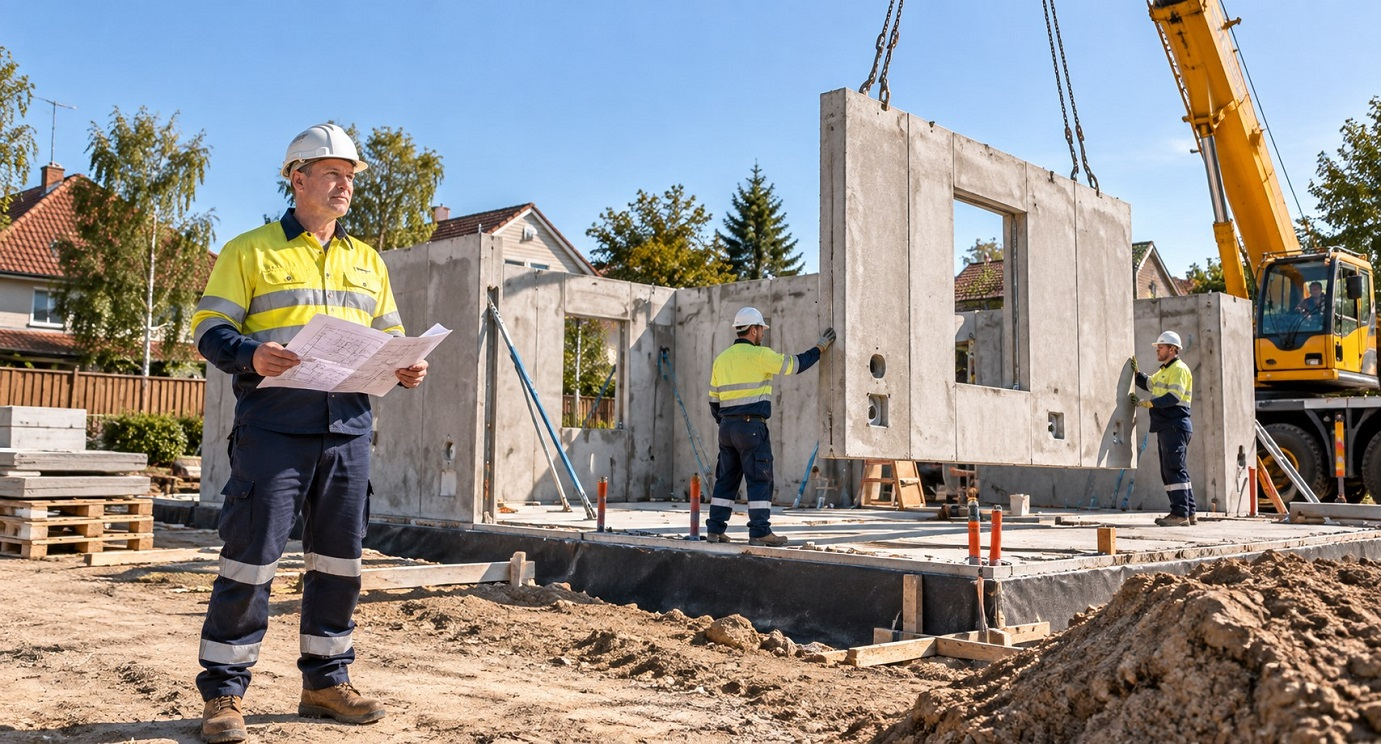
Once the foundations are complete, the wall panels are lifted into place using a crane before the roof, windows, insulation and internal finishing work begin.
Why Buyers Are Considering Liapor
The biggest advantage is speed.
Because the structural wall panels are manufactured before arriving on site, the main structure can often be assembled within one to three days. Depending on the builder, design and site conditions, many Liapor homes are completed in approximately four to six months, although larger or more complex projects may take longer.
Unlike lightweight timber or steel-frame systems, Liapor is a heavy masonry structure. The dense concrete walls provide thermal mass, helping retain warmth during colder months while slowing heat transfer during warmer weather when combined with suitable external insulation.
Factory production also improves consistency. Wall panels are manufactured under controlled conditions, producing straight walls with millimetre-level accuracy and reducing many of the small imperfections that can occur during traditional on-site masonry work.
"Many buyers want the reassurance of a solid masonry home, but they also want a faster and more predictable construction process," said Alex Markus, Chief Executive of City-Lets Ltd.
"Liapor offers an alternative between traditional brick construction and lightweight prefab homes. For many buyers, that balance is exactly what makes it appealing."
What Does a Liapor Home Cost?
Construction costs vary depending on the house design, technical specification and stage of completion.
Published pricing from Hungarian builders generally places structure-ready Liapor homes at around HUF 330,000 to HUF 380,000 per square metre, while turnkey construction typically falls between HUF 500,000 and HUF 700,000 per square metre.
As with most new-build projects, these figures should be treated as a guide rather than a guaranteed final price.
The advertised construction cost often excludes the purchase of the building plot, utility connections, site surveys, landscaping, fencing and other project-specific works. Buyers should always confirm exactly what is included before comparing quotations.
Planning Matters More Than Many Buyers Expect
One of the biggest differences between Liapor and traditional brick construction is that many decisions must be made before manufacturing begins.
Because electrical conduits and many service openings are incorporated into the factory-made wall panels, the locations of sockets, switches, lighting points and plumbing should be finalised before production starts.
Changing these later can be difficult. A brick wall can often be altered during construction. A factory-manufactured concrete wall panel offers far less flexibility once it has been produced.
For buyers, this means careful planning at the beginning of the project is essential.
Your Plot Must Be Suitable
Access is another important consideration.
Liapor wall panels are transported by large trucks and lifted into position using heavy cranes. Before choosing this construction method, buyers should confirm that their plot is suitable for delivery vehicles and lifting equipment.
Narrow streets, steep access roads, restricted turning areas or overhead utility cables may make installation more complicated and should be considered during the planning stage.
Is Liapor Better Than Brick?
There is no universal answer.
Traditional brick construction still appeals to buyers who prefer a conventional building process or expect to make changes as construction progresses.
Liapor follows a different approach. More work is completed before construction begins, allowing the on-site build to progress much faster once the wall panels arrive. The trade-off is that buyers have less flexibility to make significant changes after manufacturing has started.
The decision is less about choosing a better technology and more about selecting the building process that best suits the project.
Who Is Liapor Best Suited To?
Liapor homes are well suited to buyers who want the durability and solid feel of masonry construction while placing equal importance on predictable construction schedules and factory precision.
They are less suited to projects where the design is likely to change repeatedly during construction or where site access makes transporting large wall panels difficult.
For buyers looking to combine the permanence of traditional masonry with the efficiency of modern prefabrication, Liapor provides a practical alternative to both conventional brick building and lightweight construction.