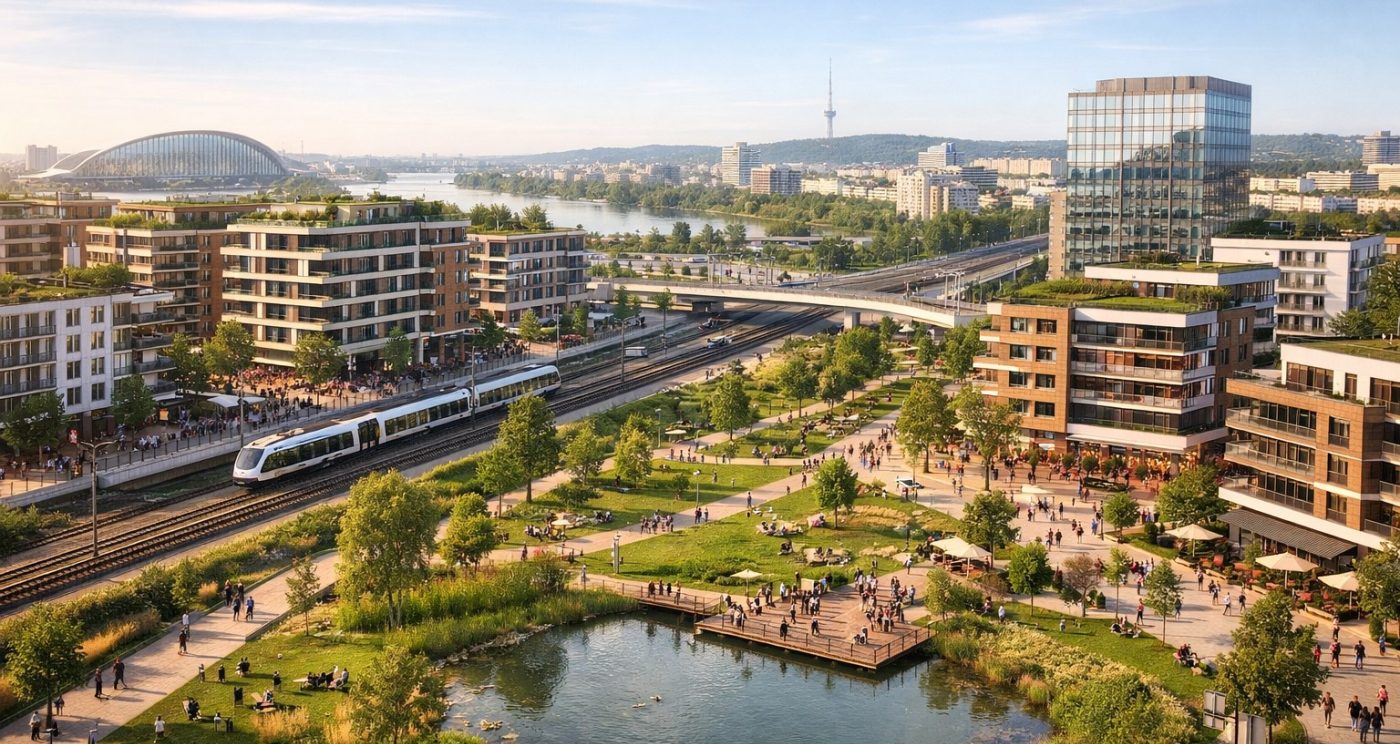
When a major new neighbourhood is announced, it is tempting to focus only on the numbers. With Déli Városkapu, the smarter approach is to look at rental yield, vacancy risk and long-term value together. Here is what the South Gate can offer investors, and what to watch so your returns stay realistic.
What kind of project is Déli Városkapu?
When investors look at a new development, the first instinct is often to ask one question: what’s the rental yield? But smart investing rarely stops there.
Déli Városkapu, also called the South Gate, is a large regeneration project planned as a mixed-use neighbourhood. Instead of being just another apartment cluster, it is designed to combine housing with workplaces, services, community facilities and generous green space.
Around a quarter of the site is planned as parks and shared public areas. From an investor perspective, that matters because neighbourhoods that feel liveable tend to attract tenants faster and hold demand more consistently, even when the wider rental market cools.
This is not a fringe location trying to get noticed. It is a strategic entry corridor being redesigned to work better for people, not just traffic.
Rental demand: the fundamentals are solid
From a rental point of view, South Gate lines up with what tenants usually pay for:
Modern apartments with efficient layouts, strong transport access, proximity to employment, and lifestyle features like parks and nearby services.
These factors do not usually create sudden rent spikes. What they do support is lower vacancy risk and steadier tenant demand over time. For many investors, that consistency is worth more than a headline-grabbing yield.
Rental yield: realistic ranges and what they mean
It helps to set expectations clearly.
New-build apartments rarely deliver the highest yields at the start. Purchase prices are higher, which naturally compresses yield compared with older stock.
Across comparable urban areas, gross rental yields commonly sit around 4% to 6%, depending on purchase price, apartment size and tenant profile. Well-priced, mid-market properties can land closer to 5% to 6%, while premium new-builds often sit around 3.5% to 5% early on.
For Déli Városkapu, a practical working range is around 4% to 5.5% gross, assuming pricing and achievable rents line up with similar modern neighbourhoods. The exact outcome will depend on what you pay, the unit type you choose, and how the finished product compares on liveability.
Why yield stability matters more here than chasing the highest number
South Gate makes the most sense as a yield-stability investment, not a yield-chasing one.
Newer apartments often lease faster, maintenance is typically lower in the early years, and energy-efficient buildings can reduce tenant turnover. Tenants also tend to accept slightly higher rents for quality, comfort and convenience.
That can mean fewer gaps between tenancies and more predictable cash flow. In real-world investing, predictability improves net returns, even when gross yield is not the highest on paper.
Phasing: the key factor that can influence short-term performance
Déli Városkapu will be delivered in stages, and that changes the rental picture.
As each phase completes, more similar apartments can enter the local rental market. In the short term, that can increase competition between landlords and slow rent growth.
The flip side is that as the neighbourhood fills in, parks open, services arrive and daily life takes shape, the area becomes more recognisable and desirable. That typically supports longer-term rental demand and resale value, even if rents do not jump immediately.
How rental yield and capital growth can work together over time
This is not a quick-flip location. The investment case is built around doing the basics well.
Early on, the focus is securing a tenant, stabilising rental income, and minimising vacancy and maintenance surprises. Later, as the neighbourhood matures, amenity delivery can improve appeal and help support both resale and rent levels.
In simple terms, the longer you hold through the neighbourhood becoming established, the more likely you are to see the full benefit of the plan.
Who this project suits best as an investment
Déli Városkapu tends to suit investors who prefer predictable rental income over high-risk yield chasing, value tenant quality and demand stability, and are comfortable holding through development stages.
If your goal is unusually high yield or a fast turnaround, this may not fit. But if you are building a balanced portfolio of reliable performers, South Gate is the kind of project that can make sense.
The bottom line
Déli Városkapu is shaping up as a fundamentals-driven investment location. Expect moderate but stable rental yields, roughly 4% to 5.5% gross, supported by modern housing, strong tenant appeal and long-term neighbourhood uplift.
For investors who think beyond year one, that combination can be more valuable than chasing the biggest number on a spreadsheet.
Quick investor Q&A
1. What rental yield should I expect?
Roughly 4% to 5.5% gross, depending on purchase price and unit type.
2. Is this a high-yield investment?
No. It is better positioned as a stability-focused investment with predictable demand.
3. Will rental demand be strong?
Modern apartments, transport access and green space typically support steady tenant interest.
4. Is this a short-term play?
No. It suits medium- to long-term holding.
5. What is the biggest risk?
Overpaying at entry. Yield always comes back to what you pay.