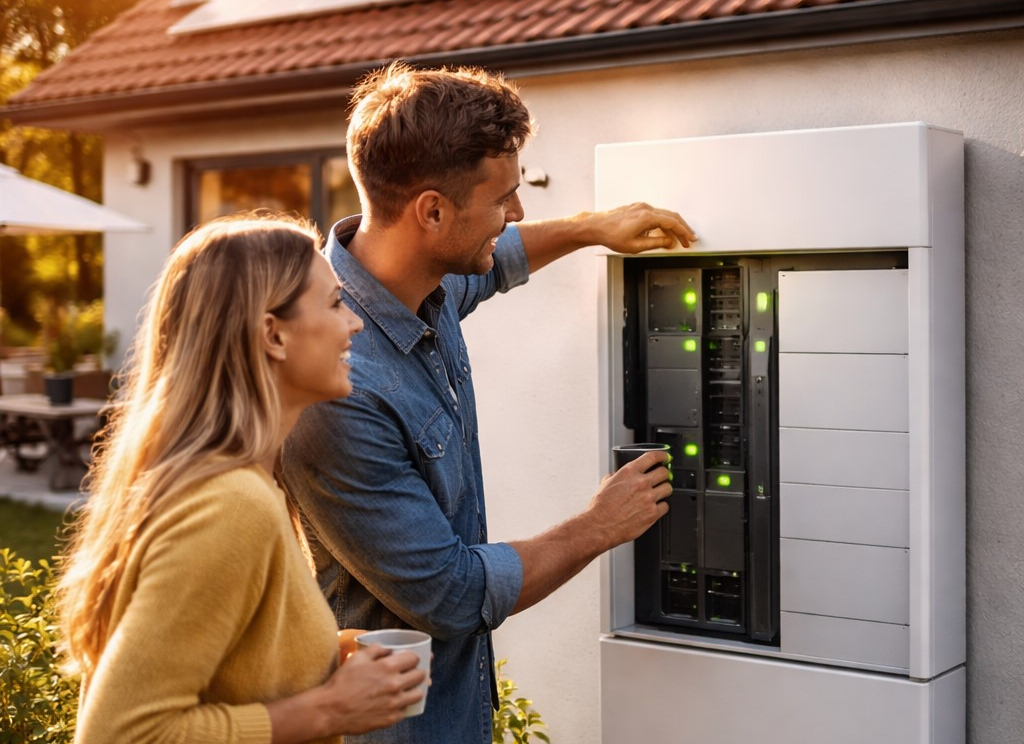
If you’ve ever checked your solar app at midday and thought, “Great… but I’m not home to use this power,” you’re not alone. Rooftop solar has surged in recent years, and the next logical step is clear: store more of your own electricity for evenings, cloudy days, and the winter stretch. That’s exactly what the new Otthoni Energiatároló Program is designed to support and it could quietly change what buyers and renters value in a home.
The headline is hard to ignore: a non-refundable grant of up to 2,500,000 HUF to help households install a home battery and related equipment, backed by a 100 billion HUF national budget.
Why this matters right now (even if you’re not “into tech”)
Residential solar has moved well beyond early adopters. Installations now number well into the hundreds of thousands, and national solar capacity has climbed close to 8 gigawatts. That scale brings a new reality: the grid doesn’t always want your extra midday power, and household economics increasingly depend on self-consumption using what you generate yourself.
A home battery lets you:
- use solar energy in the evening, when demand is highest
- reduce electricity bought from the grid during peak periods
- add resilience against short outages, depending on system setup
For homeowners, it’s a lifestyle upgrade. For landlords, it’s an increasingly persuasive value add especially as tenants compare total monthly costs, not just rent.
The grant, in plain English
The programme offers:
- Up to 2,500,000 HUF, non-refundable
- Funding based on real, itemised costs, up to 100% within the cap
- Support for homes with existing solar systems, or for those installing solar together with storage
- A total funding pool of 100 billion HUF
What costs can be included?
Eligible items typically include:
- the battery unit itself
- inverter costs, including replacement where required
- planning, permitting, metering upgrades, and electrical works needed to integrate the system
Minimum technical requirements
The storage system must provide at least 10 kWh of usable capacity (with a small tolerance). Exact requirements depend on whether solar is already installed or added as part of the project.
Who can apply and who gets priority
Applications are open to private individuals with a recognised connection to the property, such as ownership, usufruct rights, or qualifying residential use agreements.
Priority is given to households that:
- are already on gross settlement for solar feed-in, or will move to it by 2030
- are located in towns with fewer than 5,000 residents
There are also rules preventing double funding for the same storage system, while earlier support for solar-only installations does not automatically exclude applicants.
Key dates to plan around
Applications open at 10:00 on 2 February 2026.
Submissions are structured in stages, with the first main window running into mid-March.
Funding decisions are expected from mid-March 2026 onward.
Given the level of interest already seen in similar programmes, early preparation matters.
What does a 10 kWh home battery actually cost?
While prices vary by brand and installation complexity, 10 kWh battery units alone often retail in the 2.1–2.4 million HUF range. Installation, inverter upgrades, and electrical works can add to that.
This is why the grant is significant: for many households, it can cover most or all of the core battery cost, while additional works may still require some out-of-pocket spending.
Why this matters for property value and rentals
Energy efficiency is already influencing housing decisions across Europe, with studies consistently showing price premiums for homes with stronger energy performance.
In the local market, batteries pair naturally with:
- renovation projects
- insulation and heating upgrades
- green-finance incentives tied to lower household energy demand
For landlords marketing apartments in Budapest, the promise of lower monthly utility bills can be just as compelling as new finishes especially for long-term tenants.
Before you apply: a quick reality check
- Confirm whether your solar setup meets programme requirements
- Ask installers how battery size matches your real evening usage
- Check whether your inverter needs upgrading
- Prepare documentation early accuracy matters in grant schemes
- Expect installer schedules to tighten once applications open
5 quick questions homeowners are asking
1) How much support can I get?
Up to 2,500,000 HUF in non-refundable funding, based on eligible costs.
2) Do I need solar panels already?
Yes , you must either have an existing solar system or commit to installing one alongside the battery.
3) What size battery qualifies?
The system must have a minimum usable capacity of 10 kWh (with limited tolerance).
4) When can I apply?
Applications open on 2 February 2026 at 10:00.
5) Will the grant cover the full cost?
It can fund up to 100% of eligible expenses, capped at 2.5M HUF. Any costs beyond that limit would be self-funded.