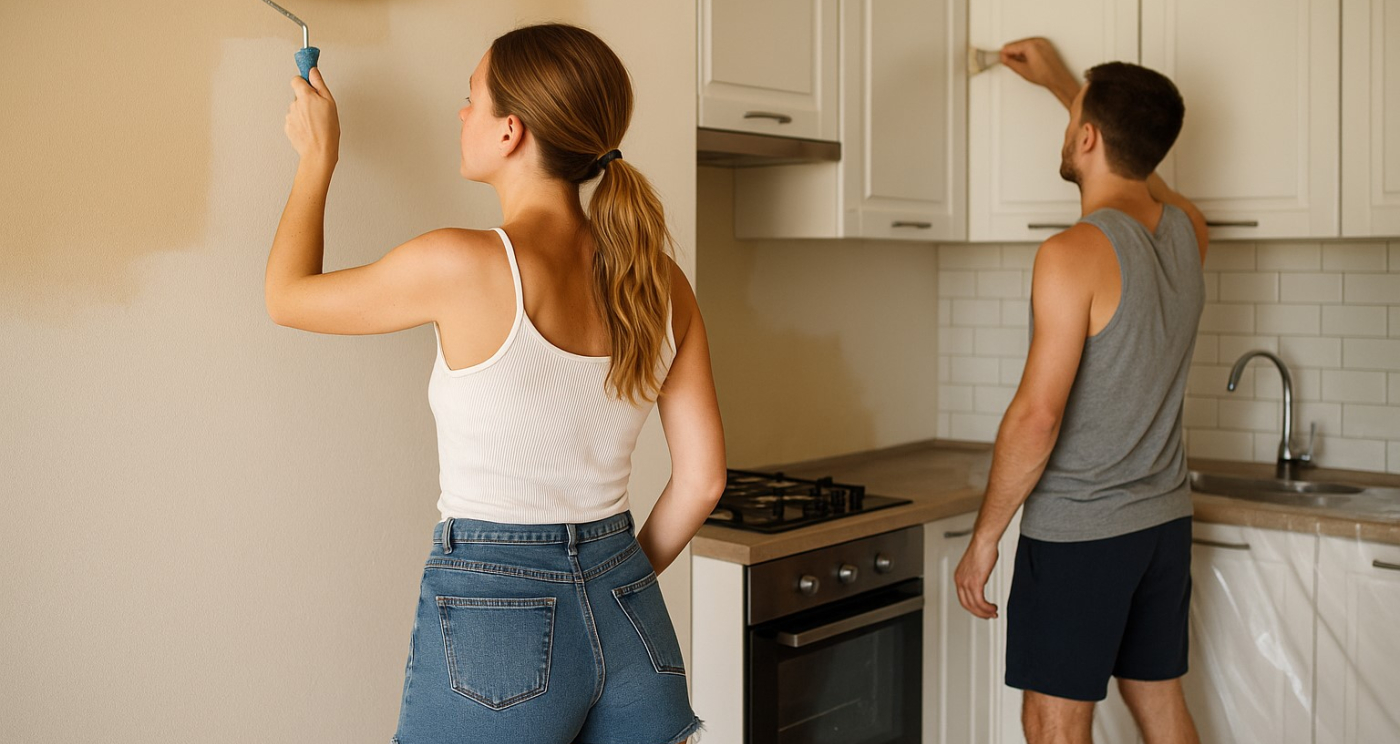
A fresh coat of paint is one of the easiest ways to make your home feel cleaner, brighter and more “you” without knocking down walls or changing the kitchen. But before you start choosing colours, it’s worth asking the big question: how much will it actually cost to paint my place?
Let’s walk through the real numbers, what drives them up (or down), and how to plan a realistic painting budget, whether you’re refreshing a cosy panel flat or a family house.
Average house painting costs in 2026
Recent price lists from local painters and renovation companies show that interior wall and ceiling painting typically costs around 1,500–3,500 Ft per m² for standard jobs using decent quality paint.
That usually covers:
-Basic surface prep (small cracks, light sanding)
-Two coats of paint on walls
-One or two coats on ceilings
-On top of labour, you’ll need to factor in materials (paint, primer, masking tape, protective foil), which often add roughly 500-1,500 Ft per m², depending on brand and quality. Premium washable or mould-resistant paints push you toward the upper end.
For exterior façade painting, current guides from painting companies suggest around 2,800-5,000 Ft per m² for standard two-coat jobs on relatively simple surfaces.
Quick rule of thumb:
-Interior repaint with average materials: ~2,000–4,500 Ft/m² (labour + materials)
-Exterior repaint: ~3,500–6,000 Ft/m², depending on height, access and condition
-These are guideline ranges your actual quote will depend heavily on the details of your home.
What really affects house painting prices?
Think of painting costs as a puzzle made of several pieces:
1. Size and wall area
Painters don’t price by the floor area, but by paintable surface, walls and ceilings. A typical apartment’s wall area is roughly 2–3 times the floor area, plus ceilings.
So a 60 m² flat might easily have 150-200 m² of wall and ceiling to paint once you add everything up.
2. Condition of the surfaces
If your walls are already smooth and you’re just refreshing the same colour, you’ll probably pay close to the lower end of the ranges.
Costs climb when:
-Old paint is flaking and must be scraped
-There’s heavy nicotine, grease or mould staining
-Deep cracks or previous DIY “repairs” need proper fixing
-Extensive preparation can add 20–50% to the labour cost because it’s time-consuming.
3. Colour changes and number of coats
Switching from a dark tone to a light one (or vice versa) often requires an extra coat or two, meaning more paint and extra labour hours.
-Same or similar colour: usually 2 coats
-Dramatic colour change: 3+ coats quite common
4. Ceiling height and access
High ceilings, stairwells and tricky corners mean ladders, scaffolding and more time, which all show up in the quote.
5. Decorative details
Doors, skirting boards, radiators, built-in shelving and fancy mouldings are priced separately – often per unit or per running metre. As a rough guide from detailed price lists, expect several thousand forint per door or window if they’re sanded and repainted properly.
6. Location and demand
Labour is usually a bit higher in the capital compared with smaller towns, simply because living and business costs are higher there.
Example: how much to paint a 60 m² apartment?
Let’s take a realistic, mid-range scenario (all prices include VAT):
-60 m² apartment
-Average ceiling height
-Standard wear and tear, no major damage
-Walls + ceilings painted in light colours
-Professional painter, mid-range materials
1. Estimate paintable area
A common rule is 2.5–3× the floor area for walls + ceilings.
Let’s take 170 m² as a middle-of-the-road example.
2. Labour cost
Using the 1,500–3,500 Ft/m² range, a typical realistic quote might sit around 2,200–2,800 Ft/m².
At 2,200 Ft/m²: 170 × 2,200 ≈ 374,000 Ft
At 2,800 Ft/m²: 170 × 2,800 ≈ 476,000 Ft
3. Materials
With decent washable paint and primer, you might spend 800–1,200 Ft/m² on materials:
170 × 800 ≈ 136,000 Ft
170 × 1,200 ≈ 204,000 Ft
So a full interior repaint of a 60 m² flat by professionals commonly lands somewhere around 510,000–680,000 Ft (including VAT), depending on finishes and prep work.
This lines up with renovation cost guides showing that for a 60–70 m² apartment, painting alone often accounts for roughly 300,000–400,000 Ft within a full refurbishment budget of about 3–3.5 million Ft.
DIY vs professional painters
You can save money by doing some or all of the work yourself – but there are trade-offs.
DIY painting – when it makes sense
DIY can be a good idea if:
-You’re repainting one or two rooms
-The walls are in good shape
-You’re happy to learn and don’t mind a few imperfections
You’ll mainly pay for:
-Paint and primer
-Tools (rollers, brushes, trays, masking tape, protective foil)
-Possibly sandpaper, filler and a basic ladder
For a single 20 m² room, DIY might cost as little as 30,000–60,000 Ft in materials if you already own some tools.
Professional painters , when they’re worth it
A pro team is usually the smarter choice when:
-You’re repainting the whole home
-There are cracks, old repairs, or multiple paint layers
-You have high ceilings or stairwells
You’re on a tight timeline or can’t live long in a “renovation zone”
Pros bring:
-Experience in surface prep (so the paint actually lasts)
-Faster turnaround – often finishing in days instead of weeks
-Safer work at height and better dust control
How to keep your painting budget under control
A few smart moves can shave serious money off the final bill:
1. Declutter and pre-prep yourself
Move furniture to the centre of the room, pack small items away and remove pictures and curtain rods. Some painters charge extra if they have to do all of this.
2. Decide your colours in advance
Changing your mind mid-project can mean extra coats and extra cost. Get colour samples, test a small patch, then commit.
3. Group rooms together
Having the painter do multiple rooms or the whole home at once is usually cheaper per m² than calling them back three times in a year.
4. Focus on high-impact areas
If your budget is tight, prioritise spaces you use and see the most: living room, kitchen, hallway. Bedrooms in good condition can sometimes wait.
5. Ask for a detailed, written quote
A good quote should break down:
-Labour (by m² or by room)
-Materials, what brand and type of paint
-Prep work, what’s included and what’s extra
-Any additional charges (scaffolding, heavy repair, furniture moving)
This makes it much easier to compare offers and avoid surprise line items later.
5-point Q&A summary
1. How much does it cost to paint a typical apartment?
For a full repaint of a 60 m² flat, expect roughly 500,000–700,000 Ft (including VAT) with professional painters, depending on wall condition, paint quality and the number of coats.
2. What’s the average price per m² for interior painting?
Most recent guides show about 1,500–3,500 Ft per m² for labour, plus around 500–1,500 Ft per m² for materials, with higher-end paints and heavy prep work costing more.
3. Is DIY always cheaper than hiring a pro?
DIY is cheaper in direct costs, but can become more expensive if you need to redo poor-quality work or buy tools you’ll barely use. For full-home repaints or tricky spaces, a pro often works out better value.
4. How often should I repaint my home?
In normal conditions, every 5–8 years is common for living areas and bedrooms; kitchens, hallways and kids’ rooms might need refreshing sooner due to stains and scuffs.
5. What’s the best way to avoid surprise extra costs?
Get at least two or three detailed written quotes, ask exactly what prep work is included, and agree in advance how extra repairs or additional coats will be charged.