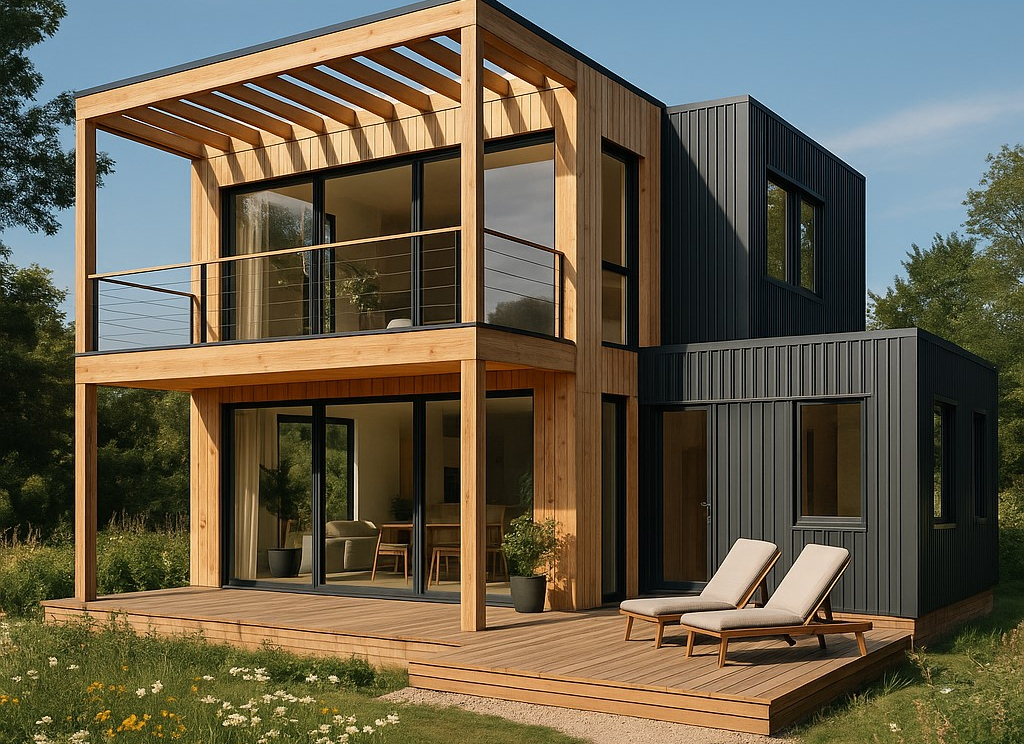
If you have ever fallen down a video rabbit hole of houses built from glass bottles, old shipping containers or even LEGO-style blocks, you are not alone. Around the world, architects and everyday owners are proving you do not need only traditional bricks and concrete to build a beautiful, comfortable home.
It might look extreme on social media, but the ideas behind these projects – recycling materials, lowering energy bills and using smarter design – are becoming surprisingly relevant for local buyers too.
With construction costs climbing to around 617,000 HUF per square metre for a new home in 2024 and new-build apartment prices in the capital often well over 1,400,000 HUF per square metre, many people are asking a simple question: is there a more inventive way to build?
This article explores how eye catching experimental homes translate into realistic options in the local market and what to think about if you are dreaming of something a bit different.
Why inventive homes are suddenly a serious option
Three big trends are pushing alternative and eco-friendly homes from quirky to genuinely sensible options.
- First, high build costs. Official statistics show that average construction costs for new detached homes have risen close to 600,000 HUF per square metre by 2023, with further increases through 2024. That means every design decision, from materials to energy systems, has a clear impact on the final budget.
- Second, stricter energy rules. Since 2021, all new homes in the European Union must meet nearly zero energy standards. In practice, this means new buildings must use very little energy and rely heavily on renewable sources. Even if you are not a committed environmentalist, an energy efficient design is no longer an optional extra; it is the new baseline.
- Third, an older, energy hungry housing stock. Many existing homes are poorly insulated and rely on outdated heating systems. Experts estimate that a deep renovation wave of well over one hundred thousand residential buildings per year would be needed to modernise the national stock. That scale of change opens the door to more creative, lower impact solutions, especially when people renovate instead of building from scratch.
Recycled and upcycled: homes that turn waste into walls
Globally, there are well known examples of homes built from recycled glass bottles, car tyres, cans and reclaimed timber. One experimental upcycle house in northern Europe cut its embodied carbon footprint by around eighty six percent compared with a conventional house simply by using salvaged materials wherever possible.
Local building codes still expect proven structure and fire performance, so full bottle or tyre walls are more of an artistic statement than a mainstream option. However, the underlying idea of using more recycled content is already creeping into everyday projects.
You can see this in reclaimed bricks and roof tiles for extensions and garden studios, reused timber beams, doors and flooring from demolished buildings, and insulation and plasterboard that contain a high proportion of recycled content.
These choices are not always as visually dramatic as a house made entirely from bottles, but they help reduce construction waste, cut embodied carbon and sometimes trim material costs on projects where labour and energy already eat a large share of the budget.
Container and modular homes: speed, flexibility and less waste
Shipping container and prefabricated modular homes have become the internet darlings of inventive building. Across Europe, specialist firms now turn second hand shipping containers or factory made steel modules into fully insulated, code compliant living spaces.
People are drawn to them for several reasons. First is speed. Modules can be installed in days rather than months once the groundworks and services are prepared. Second is predictability of cost, because much of the work happens in a factory. Third is reduced disruption on site, with fewer deliveries and less dust, noise and waste. Finally, there is flexibility: it is often easier to extend later by adding extra modules.
The catch is simple. A high quality container or modular home that meets nearly zero energy standards is usually not truly cheap. Once you add proper insulation, triple glazing and efficient heating and cooling, total costs often land in the same ballpark as a well specified conventional build, frequently in the range of six hundred thousand HUF per square metre or more, depending on finishes and location.
The real win is not a rock bottom price. Instead it is faster delivery, less construction waste and an energy efficient shell from day one, which can make a big difference to comfort and running costs over the life of the home.
Natural, bio based homes: straw, timber and hemp
Another major trend is the return of natural, bio based materials. Straw bale walls, timber frame structures and hempcrete are appearing in an increasing number of projects. These materials fit neatly with European climate and energy targets because they are renewable, store carbon and can deliver good insulation values.
In practice, many modern eco homes combine a timber frame with thick natural insulation such as wood fibre, cellulose, straw or hemp, an airtight construction with careful detailing around joints, mechanical ventilation with heat recovery to keep indoor air fresh, and renewable energy systems such as heat pumps and solar panels.
These homes may cost slightly more upfront than the most basic brick and mortar build but they can dramatically reduce heating bills, improve comfort and lower the overall carbon footprint of the project. For many owners, that mix of financial and environmental benefits is more important than an ultra experimental look.
Energy smart design is becoming mainstream and it affects prices
Inventive homes are not just about unusual materials. They are also about designing buildings that use as little energy as possible in day to day life.
Recent research in the capital's new build market found that homes with an energy rating of BB or better sell for about five point one percent more than comparable projects rated CC. That green premium suggests buyers are already willing to pay extra for comfort, lower bills and future proof standards.
At the same time, European modelling shows that nearly zero energy requirements are expected to improve the energy performance of new buildings by around seventy percent compared with 2006 levels. In simple terms, that means today’s efficient home is likely to be much more resilient in terms of running costs and regulations over the next twenty to thirty years, which is the time horizon many households now consider when making a purchase.
Is an inventive home right for you?
Going all the way to a house built entirely from bottles or tyres is probably not on the cards for most buyers. However, you can borrow many of the same ideas in a much more everyday and practical way.
There are several steps that can help you decide whether an inventive approach suits your situation.
Start with performance, not looks. When you talk to architects and developers, ask for the projected energy use in kilowatt hours per square metre per year and the planned energy rating, not just the floor plan and renderings.
Mix conventional and creative. You can use standard structural systems for simplicity of approval and financing while incorporating recycled finishes, modular elements or natural insulation where they make sense.
Think about renovation as well as new build. A smart renovation of an older home that adds insulation, high performance windows and better ventilation can dramatically cut energy use and may be more budget friendly than a completely new eco house.
Look for credible green signals. Independent certification schemes such as LEED, BREEAM or WELL indicate that a project has been checked for environmental and health performance by a third party.
Plan your budget in forint but think in life cycle terms. Higher quality building envelopes and efficient systems might add a few percent to the construction price but they can pay back through lower utility bills, better comfort and stronger resale value in a market that increasingly rewards green homes.
Quick Q and A: inventive, eco friendly homes
1. Are inventive homes legal in the local market?
Yes, as long as they meet building regulations and energy performance rules. The structure usually needs to follow certified systems, while the creativity typically sits in the materials, layout and energy concept.
2. Are these homes cheaper to build than conventional ones?
Not always. A good container, modular or eco home often costs a similar amount per square metre as a conventional home, but it can save money in the long run through lower energy use and reduced maintenance.
3. Can you get a standard mortgage for an inventive home?
Lenders mainly care about legal approvals, valuation and resale potential. A well documented, code compliant project, even if it uses unusual materials, is much easier to finance than a purely experimental build.
4. What is the biggest real benefit of an inventive home, the planet or your wallet?
In reality it is both. Efficient homes can command higher sale prices while also cutting energy bills and improving comfort and indoor air quality.
5. Where should you start if you want something different?
Begin by finding an architect or builder with proven experience in eco or innovative projects. Ask for clear numbers in forint including build cost, running cost and potential savings, and consider starting small with a highly efficient extension or garden studio before committing to a full scale inventive home.