The Concept in Plain English
The European Union has updated its rules on how efficient buildings must be, to cut emissions and reduce wasted energy in homes. The rules were adopted in 2024. Member states, including Hungary must incorporate these EU rules into their national legislation by mid-2026. After that, Hungary will decide how and when the rules affect homeowners in practice.
In effect, the changes move in two directions.
First, new buildings must be designed to produce almost no emissions and use energy more intelligently from the start.
Second, existing buildings, especially those that waste the most energy, must gradually improve their performance over time.
This distinction matters because Hungary’s housing stock is relatively old. Much of it was built before modern insulation and heating standards became common. As a result, the impact will be broad, touching everyday homes rather than a narrow segment.
Importantly, homeowners are not being forced to renovate immediately. Hungary must instead set out a clear plan to improve the worst-performing homes first.
The message is straightforward: homes that consume excessive energy will increasingly be expected to improve.
The Real-World Example
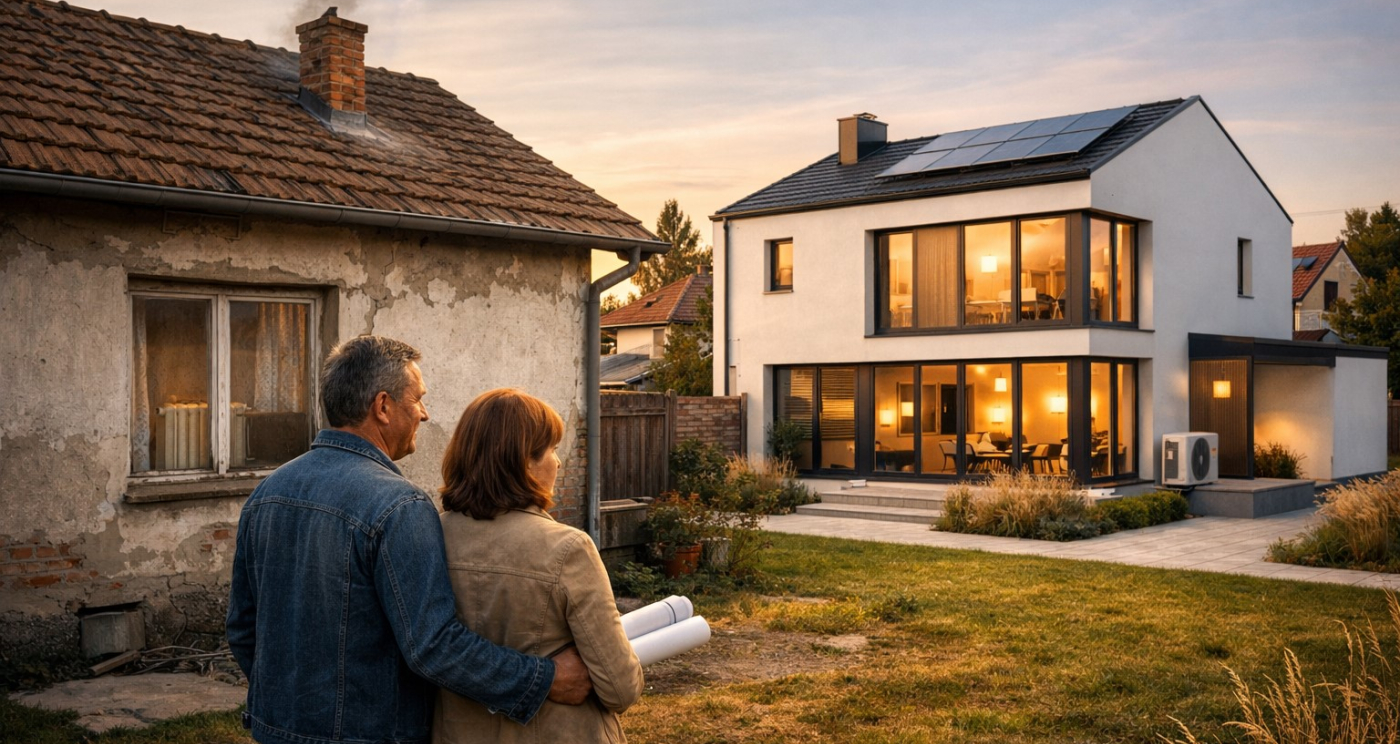
To see how this works in practice, consider a family house built several decades ago, with weak insulation, older windows and an outdated heating system.
Under the new rules, Hungary must identify homes like this and set deadlines for improving their energy efficiency. The exact requirements will be written into Hungarian law, but the overall path is already clear.
The reason for focusing on these homes is simple: upgrading the worst performers delivers the biggest results. Estimates suggest that fully renovating around 100,000 inefficient homes could reduce Hungary’s annual carbon emissions by close to half a million tonnes.
That scale explains why the rules favour full renovations over small cosmetic improvements.
For homeowners, this points toward practical decisions: better insulation, modern heating systems and improved windows.
For investors, the implications are more strategic. Properties with very poor energy performance may need capital investment to remain attractive or compliant, while efficient homes gain an advantage.
This is why energy efficiency is moving from a technical detail to a real factor in property decisions.
New Buildings vs Existing Homes
The framework draws a clear line between new and existing properties.
New residential buildings are expected to be close to zero-emission from the outset and equipped with modern, efficient energy systems.
Existing homes are treated differently. Hungary must introduce minimum energy standards that start with the least efficient buildings and become stricter over time.
In practical terms, this means new homes are built to meet future expectations automatically. Older homes may require upgrades, depending on how inefficient they are.
Why the Worst-Performing Homes Matter Most
The policy deliberately prioritises homes with the poorest energy performance.
These homes tend to be expensive to run, particularly for households with limited budgets. Improving them reduces emissions while also lowering long-term running costs.
This link between energy efficiency and household costs is central to the reform. The goal is not only to cut emissions, but also to make homes cheaper to operate for households most affected by rising energy prices.
For owners and investors alike, this means energy efficiency is likely to carry more weight as standards tighten.
Common Misunderstandings
“Every homeowner must renovate immediately.”
No. Hungary will introduce phased rules with clear timelines.
“Only new homes are affected.”
No. Existing homes, especially inefficient ones, are central to the changes.
“Energy certificates are just paperwork.”
They are becoming more relevant as minimum standards are introduced.
“This is only about the environment.”
It also affects household costs and housing quality.
Quick Summary
What is changing?
Hungary must improve the energy efficiency of its worst-performing homes under EU rules.
When does this start?
The rules must be built into Hungarian law by mid-2026.
Who is most affected?
Owners of older, poorly insulated homes.
What about new buildings?
They must meet near-zero emission and modern efficiency standards.
What should owners and investors watch?
Hungarian implementation rules, timelines and support schemes.