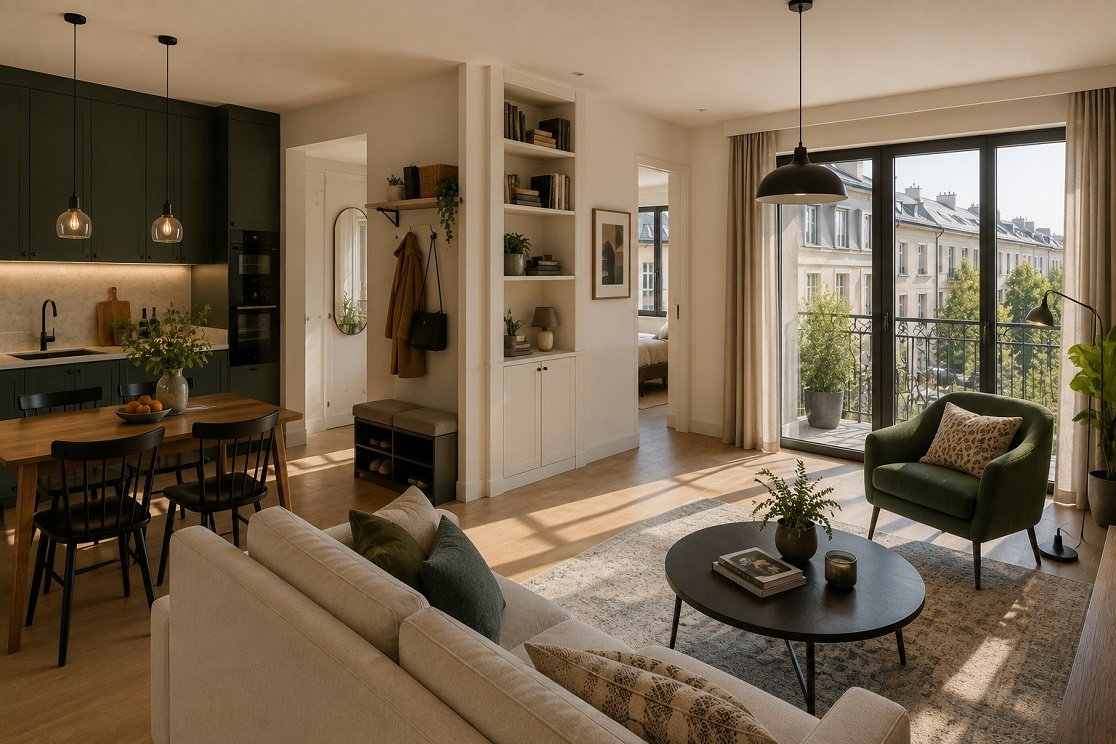
A property advertised at 55 square metres can sometimes feel larger than one advertised at 65.
Most buyers notice the number first. They compare prices, bedrooms and floor area because those are the easiest things to measure. Yet after moving in, it's rarely the square metres they think about. It's whether the home actually works.
"We've shown clients apartments that looked almost identical on paper," said Alex Markus, Chief Executive of City-Lets Ltd. "One felt comfortable the moment we walked through the door. The other felt cramped before we'd even reached the living room."
Not Every Square Metre Works Equally Hard
Imagine walking into an apartment through a long entrance hall before turning into another hallway to reach the living room.
Every metre counts towards the advertised floor area, but much of it is simply space used to move from one room to another.
Compare that with an apartment where the entrance opens directly into a bright living area with the kitchen and dining space connected naturally. Even if both properties measure the same overall size, one immediately feels more generous.
"A buyer might compare two apartments advertised at 60 square metres," Markus said. "If one loses a large part of that space to corridors and awkward circulation areas, they'll live very differently."
You Don't Notice Missing Storage During a Viewing
A ten-minute viewing rarely reveals how much storage a home really needs.
Six months later, coats are hanging over chairs, the vacuum cleaner lives in the hallway and suitcases are stacked in the bedroom because there's nowhere else to put them.
"When storage hasn't been considered properly, everyday items end up wherever they'll fit," Markus said. "The apartment hasn't become any smaller, but it often feels like it has."
Built-in wardrobes, useful kitchen cupboards and practical utility storage rarely attract the same attention as a new bathroom or modern flooring, but they often have a greater impact on daily life.
Furniture Fits. Living Around It Is Different.
An empty apartment almost always feels larger than a furnished one.
The sofa fits.
The dining table fits.
The desk fits.
But once they're all in the room, people find themselves squeezing between furniture to reach the balcony, opening cupboard doors carefully or constantly moving chairs out of the way.
"We always encourage buyers to think beyond the viewing," Markus said. "It's not about whether the furniture fits. It's about whether you can move around it comfortably every day."
Light Changes How a Room Feels
Two apartments can have almost identical floor plans.
In one, daylight reaches the back of the living room.
In the other, walls, partitions or poorly positioned furniture prevent light travelling through the space.
Neither apartment has gained or lost a single square metre, yet one often feels noticeably more open.
"It's usually the bright apartments that leave the strongest impression," Markus said. "People respond to them almost immediately."
Look Beyond the Kitchen and Bathroom
Most buyers naturally focus on kitchens, bathrooms and decorative finishes.
The layout deserves just as much attention.
Can two people cook together comfortably?
Can groceries be carried directly into the kitchen?
Will wardrobe doors open properly once the bed is in place?
Where will the ironing board, suitcase or winter coats actually be stored?
These are the details that shape everyday life long after new paint and attractive tiles have stopped feeling new.
The Best Layouts Often Go Unnoticed
The most successful layouts rarely attract attention because everything simply works.
You move naturally from one room to the next.
There's enough storage.
Furniture sits where it should.
Natural light reaches deep into the apartment.
Nothing feels awkward.
"The apartments people enjoy living in aren't always the biggest," Markus said. "They're usually the ones where every part of the home has a purpose."
Floor area will always matter when comparing properties.
But once you step inside, it's often the layout not the number on the floor plan that determines whether a home feels spacious or surprisingly small.