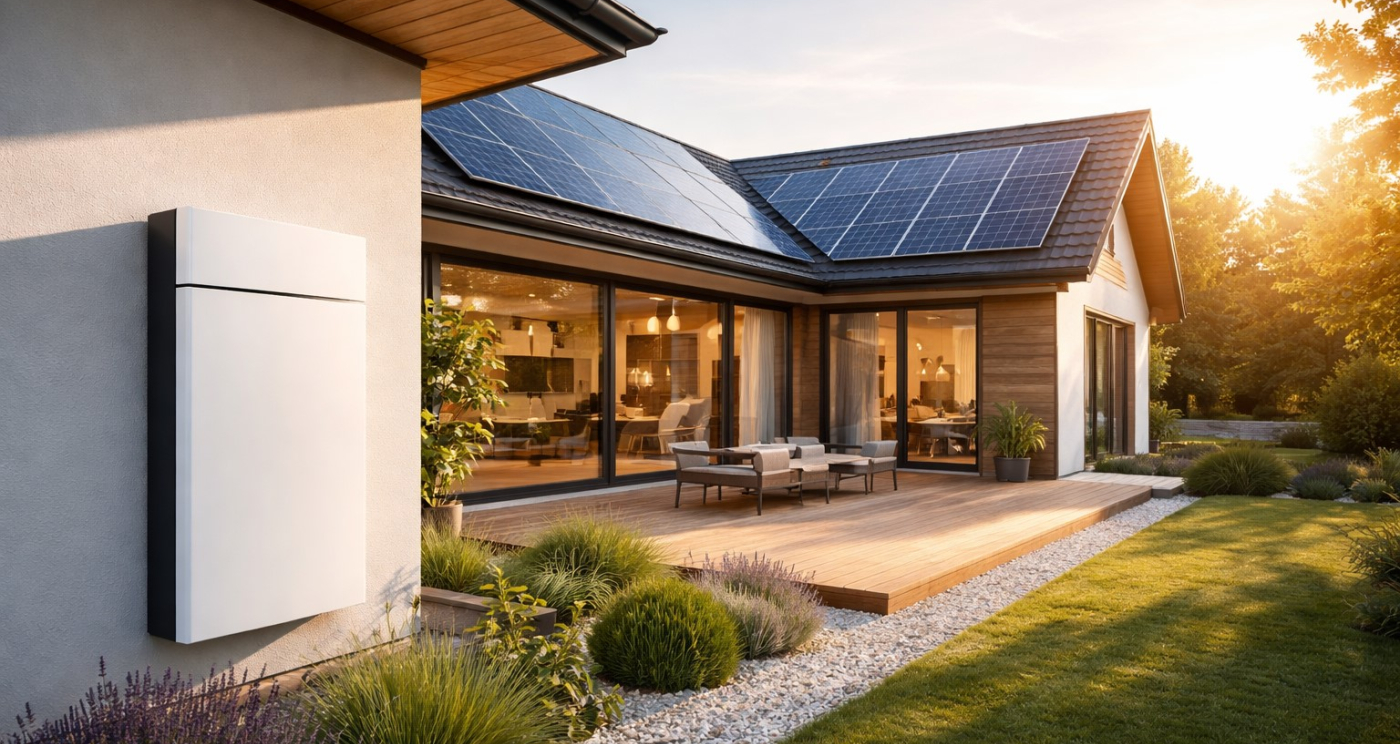
Hungary’s battery storage subsidy offers up to HUF 2.5 million in grant funding for residential energy storage. But the central question for homeowners is straightforward: Will this actually bring down your electricity bill? This article examines that question.
Rather than revisiting programme details, it looks at the everyday economics behind a home battery and whether it genuinely reduces what you pay each month. At a broader level, the issue is whether storage now represents a rational financial upgrade, rather than simply a technical addition.
How a battery changes what you buy from the grid
Solar panels produce most of their electricity around midday. A battery lets you store that energy for later use.
Solar panels reduce daytime electricity purchases. Batteries reduce evening electricity purchases, but only if there is surplus energy to store.
Without storage, unused electricity flows into the grid. In the evening, when lights, cooking and heating are running, you buy electricity back from the grid often on less favourable terms than when you sent it out earlier.
With storage, more of your energy stays at home. A qualifying system typically starts at 10 kWh of usable capacity. For many households, that covers several hours of evening demand. In larger homes, it may cover only part of it.
Plus: you rely less on the grid in the evening.
Minus: it only reduces bills if it fills and gets used regularly.
If the battery is not charged on most days for example because the solar system is small or daytime use already absorbs most solar production the battery will add only limited additional savings.
A quick check helps: open your solar app and look at how many kWh you usually send back to the grid on a sunny day. That surplus defines how much energy a battery can realistically shift into the evening.
Match storage to real surplus
A battery works best when there is consistent surplus to store.
If the solar system is modest in size, or if most production is already used during the day, a larger battery may end up partly unused.
If the property regularly sends electricity back to the grid during daylight hours, storage can reduce how much needs to be purchased later in the evening.
Choose a battery that can be filled on most sunny days not one that only fills under ideal conditions.
Plus: more of the property’s daytime solar output is shifted into the evening.
Minus: if the battery is too large, you may pay for storage capacity you rarely use.
As a simple illustration, an 8 kWh battery system may cost around HUF 2.2–2.6 million before support, while a 15 kWh system can reach HUF 3.5–4 million depending on installation complexity. If the solar panels typically generate only 5–6 kWh of surplus on a sunny day, much of the larger system may never fill despite the higher upfront cost.
The issue is not operating costs. It is allocating more capital to storage capacity that may not generate proportionate additional savings beyond what the solar system already delivers during the day.
Three practical examples
Example 1: A smaller solar system with steady evening use
A home with a 4 kWp solar system often sends some electricity back to the grid at midday. Evening use is moderate. The owner installs an 8 kWh battery.
On sunny days, the surplus charges the battery and reduces evening grid purchases. On cloudy days, less surplus is available, so the battery may only partly charge.
Plus: more of the household’s own solar power is used in the evening.
Minus: savings may vary between summer and winter.
Example 2: A medium-sized system with clear daily surplus
A household with a 6 kWp solar system regularly sends electricity back to the grid. Evening demand averages around 12 kWh on weekdays. A 10 kWh battery can cover much of that evening consumption.
Here, the battery charges and discharges on most sunny days. That regular cycling is what produces steady savings.
Plus: a noticeable reduction in evening grid purchases.
Minus: if more electricity is used during daylight hours, the benefit may decrease.
Example 3: A larger system in a higher-demand home
A larger home installs an 8 kWp solar system. Daily use trends toward 18 kWh, and an electric vehicle adds a 2 kW charging load in the evening.
Storage helps reduce evening purchases, but sustained high demand can empty the battery quickly. Once depleted, the household returns to drawing electricity from the grid.
Plus: supports heavier evening consumption with on-site solar energy.
Minus: high household demand can exhaust stored energy faster than expected.
A battery shifts energy from one part of the day to another. It does not increase total production.
When savings are most likely
From a financial perspective, savings are most likely when:
- The property generates regular daytime surplus
- A meaningful share of consumption occurs after sunset
- The owner plans to remain in the property long enough to recover the upfront cost
A battery creates measurable value when it charges and discharges on most days. If it frequently sits full or empty, the financial impact becomes smaller.
So, will your electricity bill go down?
If the property regularly sends electricity back to the grid during the day and has steady evening demand, the 2026 battery storage subsidy can meaningfully reduce electricity costs over time.
If surplus is limited or evening use is low, the reduction may be modest.
The HUF 2.5 million headline matters less than one practical question:
How much of your evening electricity can realistically come from solar energy stored earlier that day?
If most of it can, the financial case is clear.
If only a small share can, the subsidy improves affordability but may not materially reduce monthly costs.
Quick Summary
1. The subsidy lowers the upfront cost of installing a home battery.
2. Solar panels reduce daytime purchases; batteries reduce evening purchases when surplus exists.
3. Systems around 10 kWh work best when they cycle regularly.
4. Oversizing can weaken returns if surplus production is limited.
5. The financial outcome depends on how much stored solar energy replaces evening grid purchases.