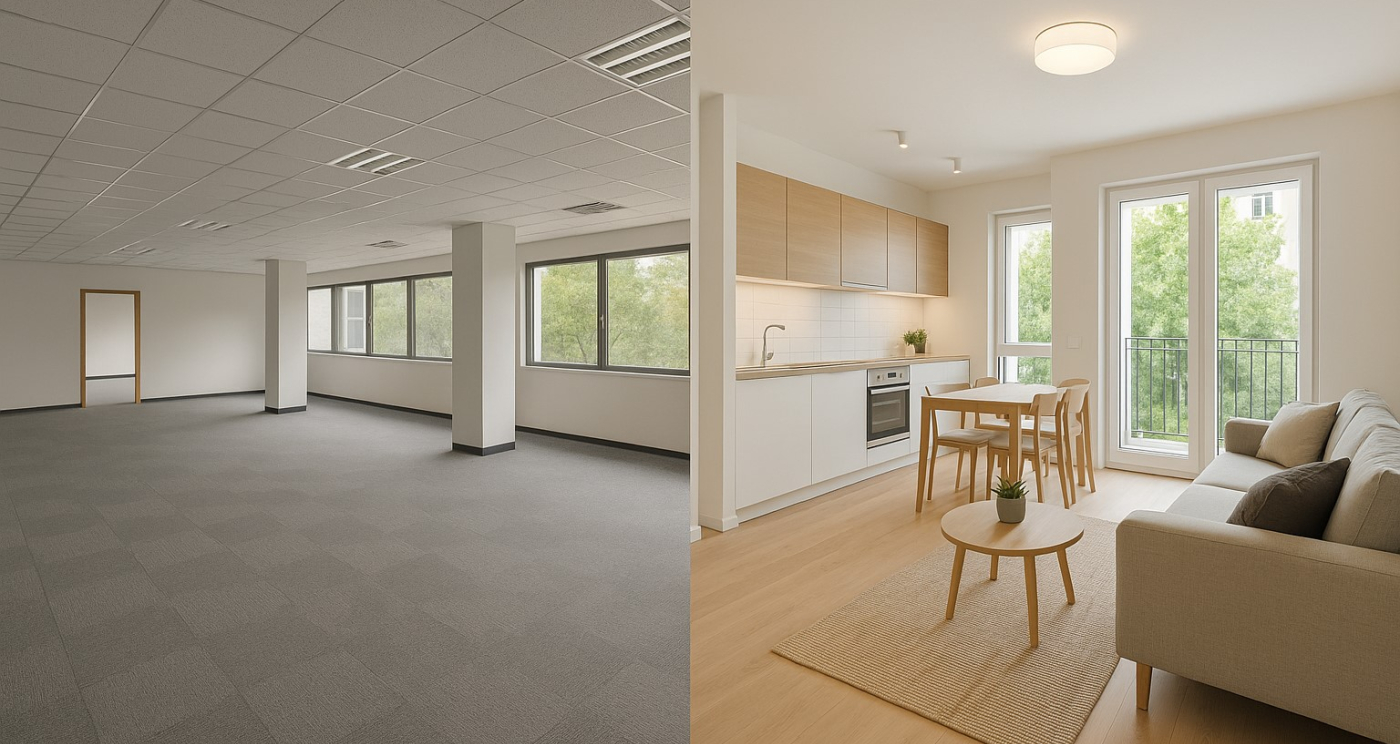
If it feels like every good flat disappears the moment it hits the portals, the numbers back you up. According to the Central Statistical Office, 13,295 new homes were completed in 2024, which is 29 percent fewer than the previous year. At the same time, the capital’s modern office market has a vacancy rate of around 13.9 percent across 4.4 million square metres of stock.
In simple terms, there are not enough new homes being built, but there are quite a lot of underused offices. This is where function change, office to residential conversion, is emerging as a practical, scalable solution.
Why turning offices into homes is back on the agenda
In a recent interview, development director István Hüse of Indotek Group explained that lower-category office buildings with weak locations or outdated technical specifications find it harder and harder to attract tenants, while centrally located, energy-efficient homes are in chronic short supply. He sees converting obsolete offices into apartments as a way to link market logic with public goals and deliver a large number of homes without building on new greenfield sites.
This thinking matches broader market trends:
- Central Statistical Office data confirms a sharp fall in new housing completions and a parallel slowdown in new building permits.
- Office reports from major consultancies show rising vacancy, especially in older B and C category buildings and peripheral submarkets.
- The rent index compiled by the Central Statistical Office and ingatlan.com indicates that nominal rents have more than doubled since 2015, with year on year growth around 7 to 10 percent in many recent months.
Why office-to-residential conversion can be cheaper, faster and greener
Multiple international and local studies show that reusing an existing structure can cut embodied carbon dioxide emissions by 50 to 75 percent compared to building a similar new block from scratch, mainly because demolition of the frame and the pouring of fresh concrete and steel are avoided.
Developers like Indotek highlight three key advantages:
- Lower total cost. Reusing the load bearing structure and part of the building services can reduce project costs by an estimated 20 to 30 percent versus a full greenfield residential scheme.
- Shorter timelines. Because the shell already exists, construction and permitting can be quicker, so homes reach the market faster at a time when new build volumes have fallen nearly a third.
- Better locations by default. Office buildings are usually close to public transport, jobs and services. When converted to housing, they automatically offer the kind of central, amenity rich locations that buyers and renters are fighting over.
Case study 1: Loft52, XIII. district – real prices from the official list
On Petneházy utca 50 to 52, the former Telekom office block is being reborn as Loft52, an apartment building under Indotek’s Rezideo brand. The project combines the heavy duty office structure with new residential layouts and extensive greening.
According to the developer’s official apartment list, currently marketed units include:
- One room flats from 33.85 to 47.10 square metres, priced roughly between 48.75 and 62.99 million forint.
- Two room units around 34.7 to 62.4 square metres, typically between 49.49 and 79.999 million forint.
- A three room ground floor apartment of 52.08 square metres at 66.99 million forint.
- The largest listed flat, 63.04 square metres, at 84.75 million forint.
All units share features such as modern insulation, three layer windows and a central heating and cooling system with individual metering, designed to keep running costs low. These figures are taken directly from the latest official price list of the project.
Case study 2: Orczy tér – offices to apartments and student housing
Around Orczy tér in District VIII, Indotek is working on a complex function change concept. One former office building is being converted into compact apartments, while the neighbouring Baross 133 block is becoming a university dormitory. Local reports emphasise that this mix of long term apartments and student housing keeps the neighbourhood alive outside office hours and helps address the shortage of affordable rooms for students near major campuses.
Case study 3: Cordia’s Corvin Campus conversion near Semmelweis University
Residential developer Cordia, part of the Futureal group, is transforming a previously office planned building next to Corvin Promenade into more than 200 apartments under the Corvin Campus by Cordia brand. Chief architect Gábor Kovács notes that this is the first full office to residential conversion in downtown Budapest, and expects over 80 percent of units to be bought by investors, thanks to strong rental demand from Semmelweis University, the metro line and Corvin Sétány. According to Cordia, the central location should support above average rental yields, especially for the targeted micro apartment segment of studios and one bedroom flats.
What this means if you are buying or investing
For owner occupiers, office to home projects offer:
- Central, well connected locations.
- Modern, energy efficient flats.
- Prices that are often competitive with or slightly below brand new greenfield projects, because the structure is reused.
For investors, they offer:
- Strong underlying rental demand from students, young professionals and city centre workers.
- The potential for good yields, especially in compact units where price per square metre is moderate but rent per square metre is high.
- Exposure to an eco conscious segment that may hold its value well as energy costs and regulations tighten.
As István Hüse has argued in several interviews, large scale function change could bring thousands of new homes to the market in coming years if regulators, municipalities and developers work together.
5 quick Q&As on office-to-home conversions
Why are office-to-residential conversions becoming popular now?
Because new housing output has fallen sharply while office vacancy has risen to around 13.9 percent, leaving a pool of underused buildings in good locations that can be repurposed into homes.
How much cheaper is conversion than building new?
Industry estimates and developer feedback indicate that reusing a structure can cut total project costs by roughly 20 to 30 percent, mainly by avoiding full structural works and some infrastructure spending.
Is conversion really greener?
Yes. Studies show 50 to 75 percent lower embodied carbon dioxide emissions versus comparable new builds, plus a big reduction in demolition waste when the frame and facade are retained.
What kind of flats do these projects create?
Mostly compact studios and one bedroom units with upgraded insulation, modern windows and efficient heating and cooling systems, as seen at Loft52 and Corvin Campus.
What should I check before buying in a converted building?
Confirm the technical upgrades, the legal status of the function change, service charges and any special rules in the condominium. If those boxes are ticked, an office to home flat can be a smart, sustainable addition to your property portfolio.