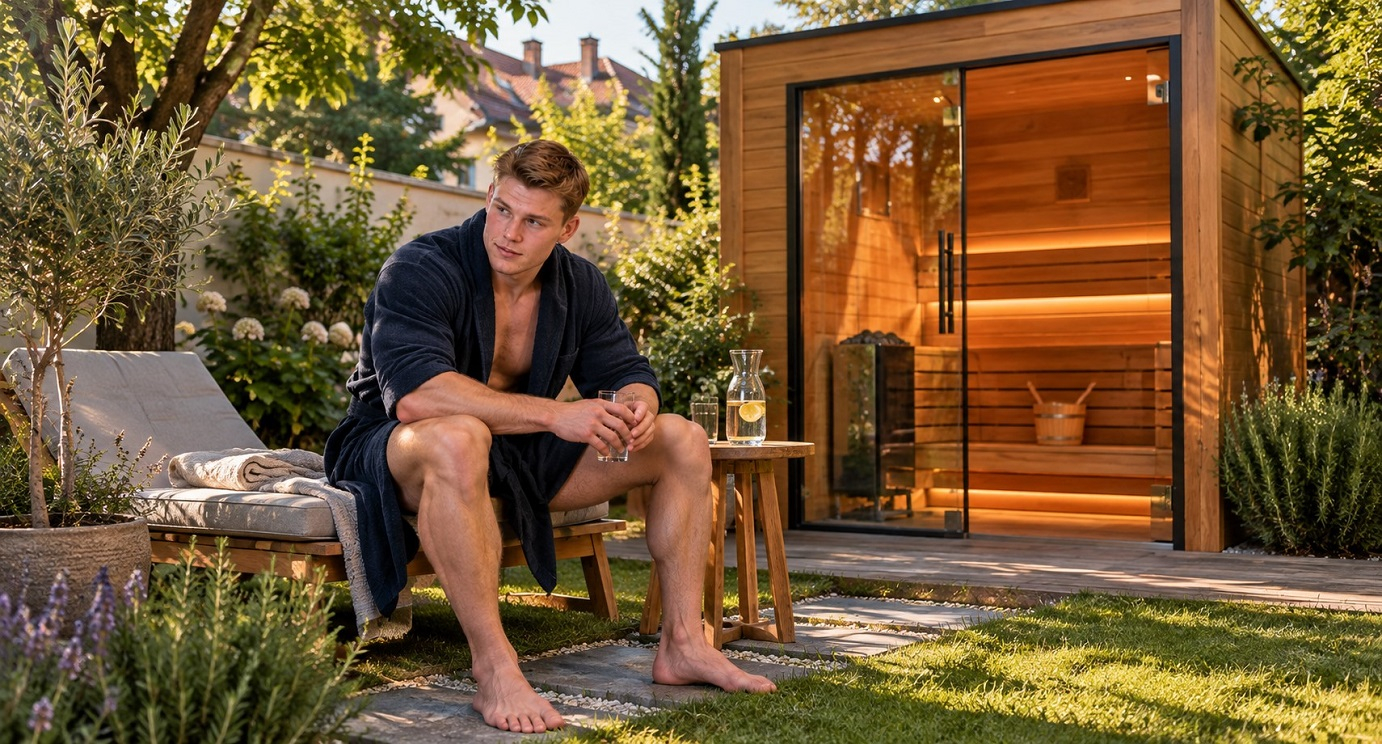
Home cinemas and wine cellars once defined luxury homes. Increasingly, homeowners are making room for something different: saunas, wellness rooms and spaces designed purely for relaxation.
International property reports have highlighted growing interest in homes that support wellbeing, with wellness-focused spaces becoming one of the more noticeable design trends in residential property. In Hungary, one of the clearest examples is the growing popularity of home saunas.
Home Saunas Are Moving Beyond Luxury Properties
Not long ago, a home sauna typically meant a large detached house with significant space and budget.
Today, homeowners have far more options. Compact infrared cabins designed for one or two people can fit into spare rooms, larger bathrooms, enclosed balconies or unused corners of a home. Some homeowners are installing outdoor sauna cabins in gardens, while others are converting underused rooms into dedicated wellness spaces.
"Most homeowners are not building dedicated wellness wings," said Alex Markus, Chief Executive of City-Lets Ltd.
"They are usually looking for one part of the home they can use better. A spare bedroom, an enclosed balcony, a garden building or even a quiet corner can become a place to switch off if it is planned properly."
What Does a Home Sauna Cost?
According to recent Hungarian market estimates, smaller infrared saunas can start from around HUF 300,000, while larger premium infrared models can reach approximately HUF 1.5-1.7 million.
Traditional Finnish saunas generally start from around HUF 480,000 and increase depending on size, materials and installation requirements. Combination saunas that offer both infrared and Finnish sauna functions are often priced between HUF 1.9 million and HUF 2.1 million, while larger custom-built premium installations can start from HUF 4-5 million and rise significantly from there.
As with kitchens or bathrooms, the final cost depends on the level of finish, materials, technology and installation complexity.
The Best Sauna Is the One You'll Actually Use
One of the most useful observations from sauna specialists is also one of the simplest.
The best sauna is not necessarily the largest, the most expensive or the most impressive. It is the one that fits naturally into everyday life.
For some homeowners, that may be a traditional Finnish sauna in a garden building where family and friends can enjoy the full sauna experience. For others, a compact infrared cabin that heats quickly, requires minimal preparation and can be used after work may be a more practical choice.
The decision often comes down to routine rather than prestige. A sauna that fits comfortably into an existing room and becomes part of a weekly habit may ultimately provide more value than a larger installation that is rarely used.
Spare Rooms Are Being Used Differently
A room that once stored boxes, old furniture and seasonal decorations may now be a sauna room, reading retreat, yoga space or small fitness area.
Some homeowners are incorporating cold-plunge tubs, while others are creating outdoor wellness terraces or garden relaxation zones. These spaces do not always require major renovation work. Often the goal is simply to create a dedicated area for slowing down and stepping away from daily routines.
"The interesting thing is that many of these projects are relatively modest," Markus said.
"A homeowner may not have space for a pool or a large extension, but they can often create a sauna corner, reading room or small wellness area within the footprint they already have."
A Different Way of Thinking About Home Improvements
Location, layout, natural light and storage remain some of the most important features buyers look for in a property. Wellness spaces are unlikely to replace those fundamentals, but they are becoming part of how some owners think about improving daily life at home.
"Most homeowners are not trying to recreate a luxury spa," Markus said.
"They are usually looking for a simple space where they can switch off for half an hour at the end of the day. That is why compact wellness solutions are becoming more appealing than many people realise."
The growing popularity of home saunas suggests that wellness is no longer viewed as something that only happens at a spa or health club. Increasingly, it is becoming part of everyday living. For many homeowners, creating a space to relax and recharge is becoming just as important as creating a space to work, cook or entertain.