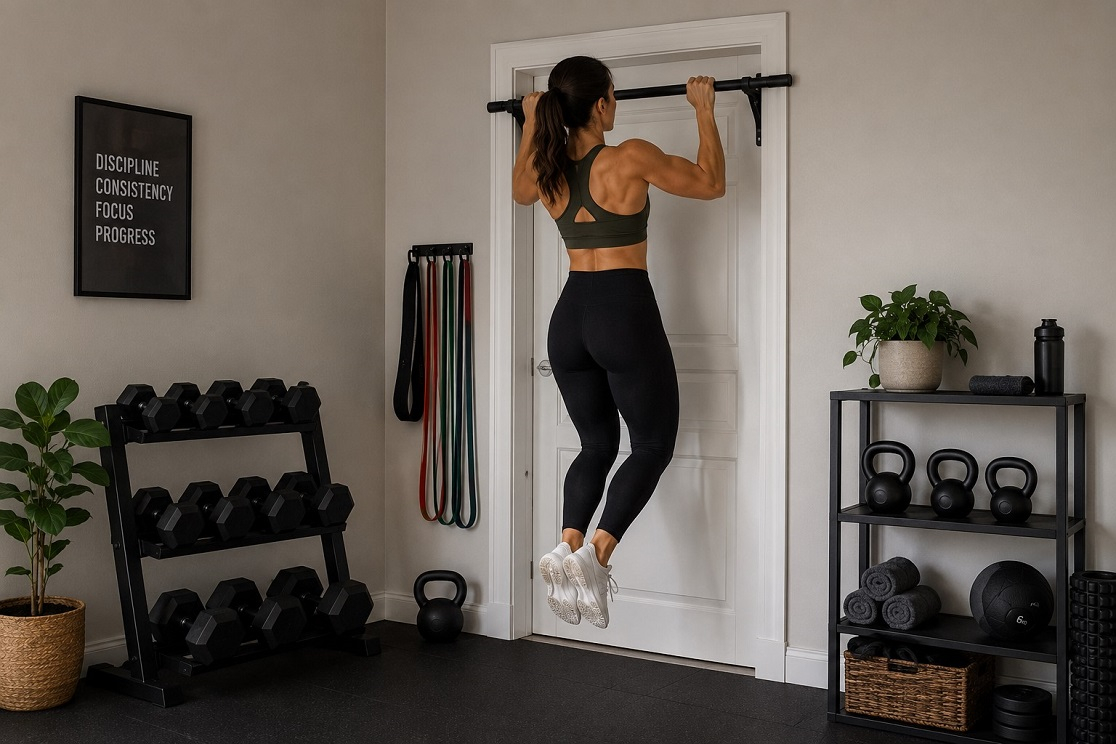
Home gyms are becoming a common feature in modern homes, but many homeowners make the same mistake. They buy equipment first and only then discover it doesn't fit the room or the way they like to train.
A spare bedroom, garage or other unused room can become an effective place to exercise without taking over the entire house.
1. Plan the Room Before Buying Equipment
Many home gyms begin with an online shopping list instead of a floor plan.
Before buying equipment, measure the room carefully. Leave enough space to move safely around a bench and other equipment, and consider ceiling height if you plan to perform overhead exercises or install a pull-up bar.
Think about the room itself before thinking about the equipment. Natural light, ventilation and power outlets are much easier to plan before machines and storage are in place.
If the room will also serve as a guest bedroom, home office or hobby room, choose equipment that can be folded away or stored easily rather than permanently filling the space.
2. Choose Versatile Equipment Instead of Filling the Room
Commercial gyms contain dozens of machines because they need to cater for hundreds of members. A home gym only needs equipment you'll actually use.
Adjustable dumbbells remain one of the best investments because they replace multiple pairs of fixed weights while taking up very little space. Combined with an adjustable bench, they allow a wide variety of upper-body, lower-body and core exercises.
A pull-up bar is another excellent addition. It provides a stable platform for pull-ups, chin-ups and hanging leg raises while allowing progressive overload by adding weight as your strength improves.
Gymnastics rings add even more versatility. Because they move freely, your wrists, elbows and shoulders follow a more natural path than they do on a fixed bar. The instability also forces the shoulders, forearms and core to work harder, making rings one of the most effective tools for bodyweight strength training.
A kettlebell complements both bodyweight and traditional weight training. Exercises such as swings, cleans and snatches develop explosive hip power, cardiovascular fitness and grip strength, while the off-centre weight challenges balance and core stability in ways that conventional dumbbells cannot.
Resistance bands complete the setup. They're inexpensive, easy to store and useful for mobility work, stretching, assisted pull-ups and adding resistance to many strength exercises.
If cardio is an important part of your routine, a treadmill or rowing machine may also be worthwhile. Otherwise, add equipment gradually as your training develops rather than filling the room with large machines that may see little use.
3. Build a Room You'll Enjoy Using
A good workout space depends on more than the equipment inside it.
Rubber flooring helps protect both the floor and free weights while reducing vibration and noise, making it particularly useful in apartments or upstairs rooms.
Ventilation becomes increasingly important during longer workouts. Opening windows, installing a ceiling fan or using air conditioning can make training much more comfortable, particularly during Hungary's increasingly hot summers.
Storage deserves just as much attention. Wall-mounted racks, shelving and storage benches keep equipment organised and the floor clear, making it easier to start training without first moving furniture or unpacking weights.
"I've trained in commercial gyms for years, but one advantage of a home gym is convenience," said Alex Markus, Chief Executive of City-Lets Ltd. "If you can start your workout in two minutes instead of twenty, you're much more likely to stay consistent."
4. Design the Room for the Future
A dedicated gym may suit your needs today, but they can change surprisingly quickly.
A spare room that works as a gym today may become a nursery, home office or guest bedroom in a few years. Choosing equipment that can be stored away or removed easily allows the room to adapt without major renovation.
That flexibility can also make a property more attractive to future buyers. Not everyone wants a home gym, but almost everyone values an extra room that can be adapted to suit changing needs.
"The best home gyms don't have to take over an entire room," Markus said. "A space that's easy to train in today should still be useful for something else if your needs change in the future."
A successful home gym isn't measured by how much equipment it contains. It's measured by whether it becomes part of your routine. A well-planned room with versatile equipment is usually more useful than one filled with expensive machines that leave little space to move.