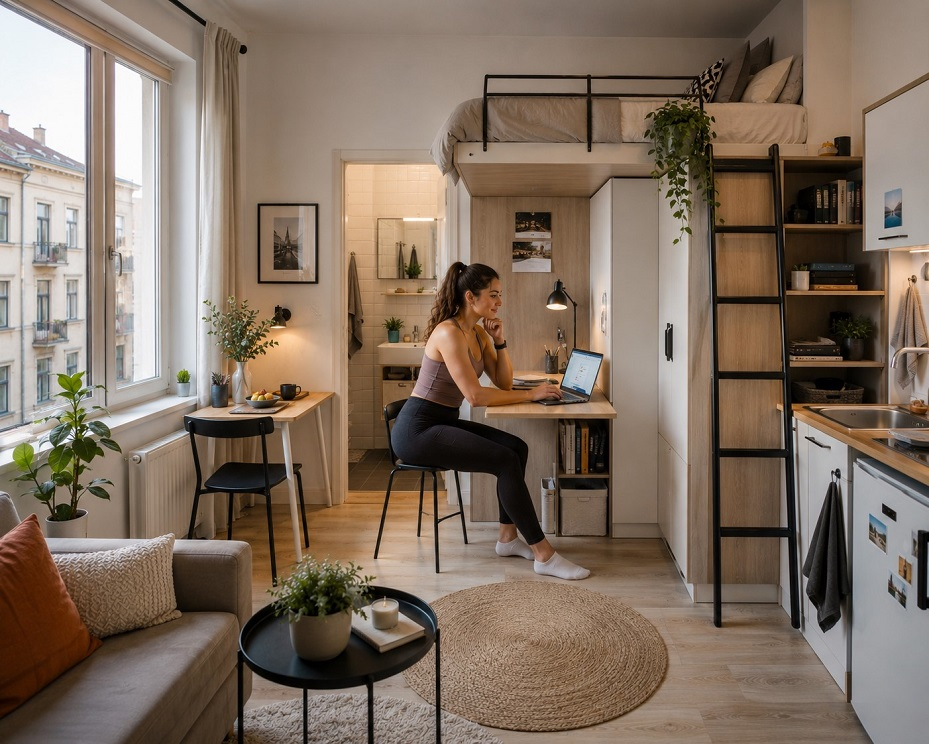
Micro apartments are not a new idea internationally. Popular in cities such as London, Warsaw, Tokyo and Singapore, they are generally defined as homes ranging from around 11.5 square metres up to approximately 50 square metres.
Budapest is no exception. Apartments at the very bottom of that size range can still be found on the market, while compact studios and small one-room homes have become an increasingly visible segment of the capital's housing market.
Recent market analysis suggests growing attention towards these smaller properties as buyers, renters and investors respond to changing housing costs and affordability pressures. While micro apartments represent only a small share of overall transactions, they are attracting interest because they offer a different entry point into some of Budapest's most sought-after locations.
Small Homes, Premium Prices
One of the more surprising findings is that micro apartments are not necessarily cheap when measured by square metre prices.
According to recent market analysis, apartments under 25 square metres in Budapest are selling for approximately 12% more per square metre than the average used apartment. More than 80% of transactions in this category were completed above HUF 1 million per square metre.
Prices ranged from approximately HUF 650,000 to HUF 2.5 million per square metre, with the highest figures typically attached to the smallest and best-located homes.
This reflects a trend seen in many major cities. While the total purchase price may be lower because the apartment itself is smaller, the value of the location often remains significant.
Location Continues to Drive Demand
Many of Budapest's micro apartments are concentrated in central districts, like V and VI, where sqm prices are higher, and demand has historically been strong.
Properties in central locations, close to public transport, universities, workplaces, restaurants and entertainment areas continue to attract attention from both buyers and tenants.
The appeal of these apartments is often linked to accessibility and convenience. In a city where location remains one of the most important drivers of property values, smaller homes can provide access to neighbourhoods that might otherwise require a substantially larger budget.
Design Matters More When Space Is Limited
As apartment size decreases, every design decision carries more weight.
Many of the most successful micro apartments rely on solutions that make the home feel larger without adding a single square metre. Floor-to-ceiling cabinetry can transform an entire wall into storage while keeping the room visually clean. Raised beds with built-in drawers use space that would otherwise sit empty. Folding dining tables, wall-mounted desks and movable furniture allow one room to serve several functions throughout the day.
Natural light also plays an important role. Large windows, glass partitions and lighter colour palettes can help compact homes feel more open, while reducing visual clutter often makes rooms feel noticeably larger than their floor area would suggest.
"The most successful small apartments aren't necessarily the largest," said Alex Markus, Chief Executive of City-Lets Ltd.
"They're the ones where the space has been thought through carefully. We've seen apartments under 25 square metres that feel surprisingly comfortable because storage, furniture placement and natural light were considered from the beginning."
Even simple changes can make a difference. Using vertical wall space, incorporating storage beneath seating, replacing bulky furniture with built-in solutions and reducing unnecessary internal partitions are all common approaches used to maximise compact homes.
A Growing Part of the Rental Market
Micro apartments also continue to attract interest from landlords and investors.
Their smaller size often results in a lower overall purchase price than larger apartments in the same location, while demand from tenants remains present in many central districts. Recent market data suggests that supply remains relatively limited, which has helped keep attention focused on the segment despite its small share of overall housing transactions.
Not a Replacement for Traditional Homes
Micro apartments are unlikely to replace larger homes, and they are not suitable for every household.
Space requirements vary significantly depending on lifestyle, family size and working arrangements. However, the growing visibility of micro apartments highlights how housing markets adapt to changing affordability, location preferences and buyer priorities.
What is clear is that compact homes have become an established part of Budapest's property market rather than a novelty.
More Than a Niche Trend
Budapest's micro apartment trend reflects broader changes taking place across many urban housing markets.
The growing visibility of these homes shows that size is only one factor in the housing market. Despite offering the fewest square metres, many micro apartments are achieving some of the highest prices per square metre in the city.
As affordability continues to shape buying decisions, compact homes are becoming an increasingly established part of Budapest's property market rather than a niche curiosity. For buyers, renters and investors alike, they are likely to remain a segment worth watching in the years ahead.