
Most buyers think buying a home is about saving a 20% deposit.
In reality, the deposit is only one part of the money you'll need. Taxes, legal fees, bank charges and the bank's own valuation can all affect how much cash you need before the purchase can go ahead.
Why Most Buyers Still Need 20%
For most market-rate mortgages, Hungarian banks will lend up to 80% of a property's appraised value. Buyers normally provide the remaining 20% themselves.
The important detail is that the loan is based on the bank's valuation, not necessarily the price agreed with the seller.
For example, you agree to buy a property for HUF 60 million, but the bank values it at HUF 55 million. Instead of lending up to HUF 48 million, the bank will normally lend up to HUF 44 million. The buyer must cover not only the deposit, but also the HUF 5 million valuation gap.
For a typical purchase:
- HUF 60 million home: minimum 20% deposit of HUF 12 million
- HUF 80 million home: minimum 20% deposit of HUF 16 million
The deposit is only the starting point.
When Is a 10% Deposit Possible?
Eligible first-home buyers may qualify for the government's Otthon Start programme.
The scheme offers:
- Fixed 3% interest for the full loan term.
- Maximum loan of HUF 50 million.
- Repayment period of up to 25 years.
- Minimum 10% deposit for eligible applicants.
- The headline figure can be misleading.
Take a HUF 60 million property.
A 10% deposit suggests the buyer needs HUF 6 million.
However, because the subsidised loan is capped at HUF 50 million, the buyer must still contribute HUF 10 million before paying any taxes or purchase costs.
A lower deposit does not always mean less cash.
The Costs Most Buyers Forget
The deposit is rarely the biggest surprise.
Typical purchase costs also include:
- Property transfer tax: 4%
- Lawyer's fee: typically 1% to 1.5%
- Property valuation: approximately HUF 30,000-50,000
- Mortgage registration and bank fees, depending on the lender
A buyer purchasing a HUF 60 million property can typically expect:
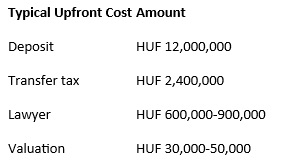
Before moving costs, furnishing or renovation, buyers should expect to have around HUF 15 million to HUF 15.5 million available.
Buying an HUF 80 million home can easily require close to HUF 20 million before completion.
Another Property Can Reduce the Cash You Need
Many buyers assume cash is the only way to satisfy a bank's lending requirements.
That is not always the case.
If you already own another property, or a close family member is willing to offer theirs as additional collateral (pótfedezet), the bank may assess both properties together when deciding how much it is prepared to lend.
For example:
- Home being purchased: HUF 60 million
- Existing debt-free property offered as collateral: HUF 40 million
Instead of relying solely on the new purchase as security, the bank now has HUF 100 million worth of property supporting the loan.
Depending on the lender and the overall application, this can significantly reduce—or in some cases eliminate the need for a cash deposit.
However, additional collateral only addresses one part of the bank's assessment.
It does not replace the income assessment.
Income Is Assessed Separately
Every Hungarian mortgage application must satisfy two independent tests.
The first asks whether there is sufficient collateral for the loan.
The second asks whether the borrower can comfortably afford the repayments.
Under the Hungarian National Bank's debt-to-income (JTM) rules:
- Buyers earning less than HUF 800,000 net per month are generally limited to mortgage repayments of 50% of their verified net income.
- Buyers earning HUF 800,000 net or more may generally borrow up to 60% of their verified net income, depending on the loan structure.
- In practice, income often becomes the limiting factor even when buyers have sufficient property security.
Banks also expect stable employment. Most lenders require:
- an indefinite employment contract after the probation period,
- at least three months of verified employment,
- or up to six months of income history for self-employed applicants.
Although Hungary's legal minimum wage is HUF 322,800, and the guaranteed minimum wage is HUF 373,200, buyers seeking an average mortgage generally need considerably higher earnings.
Applicants borrowing the maximum HUF 50 million Otthon Start loan typically need a verified net monthly income of around HUF 500,000 to HUF 550,000.
Larger market-rate mortgages generally require HUF 500,000 to HUF 600,000 or more, depending on the loan amount, existing debts and the lender's own affordability assessment.
Two Buyers With the Same Salary Can Receive Different Decisions
Two buyers earning exactly the same income can receive very different mortgage offers.
One may qualify because they own another property that can be used as additional collateral.
The other may be asked for a much larger cash contribution.
Likewise, a buyer with substantial property assets may still be declined if their income does not meet the bank's affordability requirements.
"Many buyers think the deposit is the biggest hurdle. In practice, it's only one part of the bank's decision," said Alex Markus, Chief Executive of City-Lets Ltd.
"Banks assess two things independently: whether the loan is properly secured and whether the borrower can comfortably afford the repayments. Passing one test doesn't automatically mean you'll pass the other."
Before searching for a property, calculate more than the deposit.
Work out how much cash you'll need to complete the purchase, how much the bank is likely to lend, and whether your income is sufficient to support the repayments. Those three figures provide a far more realistic picture of what you can actually afford.